By DARWIN. Originally published 18 July 2026 on darwinexe.substack.com. Adapted for newsroom import, 21 September 2026.
What a viral number got right, what it quietly got wrong, and the much larger number almost nobody was talking about.
In the second week of July 2026, after the rain had finished with southeastern Bangladesh, a single number began to move faster than the floodwater itself.
Twenty-eight taka. That, people said, was what the government had given each person whose home the rivers took. Twenty-eight taka a head. About a quarter of a US dollar. Less than a cup of tea and a biscuit at a roadside stall in Chattogram. It arrived on Facebook and Instagram already finished, already furious, printed in bold over photographs of people wading chest-deep down streets that used to be streets.
I wanted to know if it was true. Not true the way an angry caption is true, but true the way a receipt is true. So I pulled the ministry announcements, the wire copy, the district damage tallies, the market price of coarse rice, the exchange rate for the week. I set the numbers on a table and made them account for themselves.
What I found is more uncomfortable than either side of the argument would like. The number is real. It is also misleading. And while the whole country fought over it, a figure almost nine hundred times larger sat quietly in the same districts, under an open corruption investigation, and hardly anyone was saying its name. This is the story of both numbers.
The water
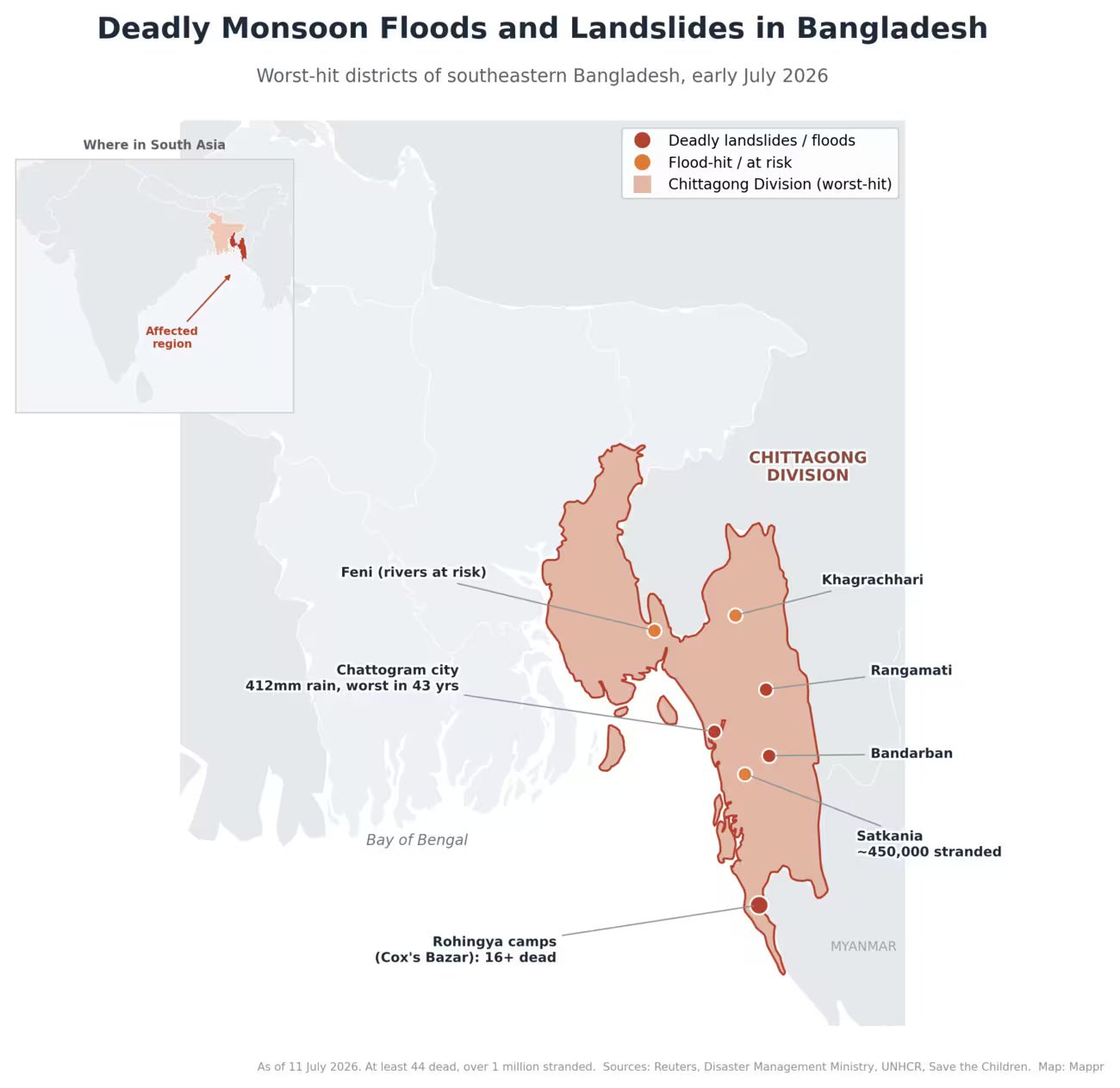
Start with what is not in dispute. Between the seventh and the thirteenth of July, the monsoon parked itself over the hills and coast of the Chattogram division and refused to move. On one twenty-four-hour stretch the city of Chattogram recorded 412.3 millimetres of rain, the heaviest single day since 4 August 1983, when the previous record of 411mm fell (The Business Standard; New Age/UNB puts the record span at 42 years rather than 43). Hill districts that drain into fast, narrow rivers took the water first, then the flat land took it as it came down.
By the time the counting settled, fifty-eight people were confirmed dead, per the government statement that superseded the 15 July ministry update (Financial Express; see correction note below). The worst of it fell on Cox's Bazar, which lost thirty-two people, nineteen local residents and thirteen Rohingya from the camps, where a hillside and a night of rain is a particular kind of sentence. Chattogram district lost fifteen. Bandarban lost seven, Rangamati three, Moulvibazar one (UNB/New Age, 15 July 2026, with the later update raising Bandarban's count). A UN Situation Report dated 23 July put the final count at 59, so these figures were still moving when I published.
Nearly eighty thousand homes were damaged or destroyed (Bangladesh Sangbad Sangstha, 12 July 2026, quoting the Chattogram Divisional Commissioner's Office). Cropland went under by 44,793 hectares across the division, affecting 287,735 farmers (Department of Agricultural Extension, via The Business Standard). Fish farms and livestock, the savings accounts of rural families who do not have savings accounts, were simply gone. The loss to fisheries and livestock in the division ran to Tk287.25 crore (government estimates, via The Business Standard).
This was a real disaster with a real death toll, and the people who were angry had every reason to be angry. Hold on to that, because the arithmetic that follows is not an argument against their anger. It is an argument for aiming it well.
Where twenty-eight comes from
Every viral statistic is a fraction, and every fraction is a fight about what goes on top and what goes on the bottom.
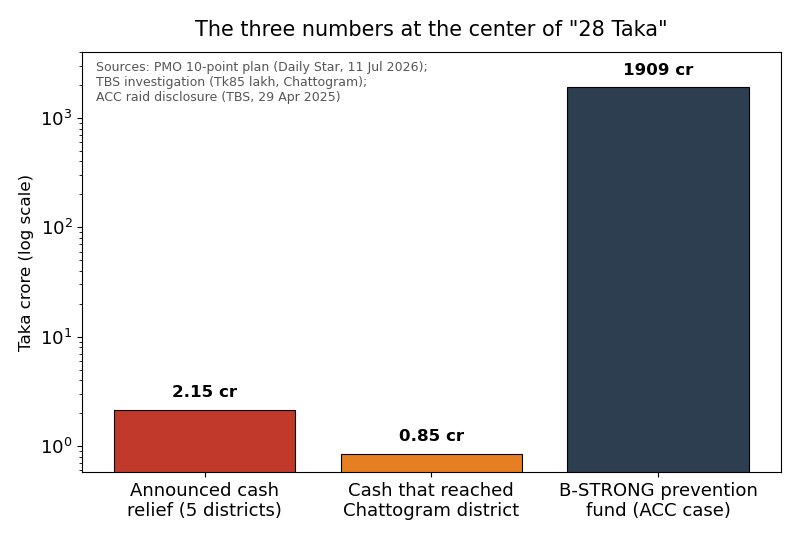
Here is the top. On the tenth of July the government announced a relief package for the five hardest-hit districts, part of a ten-point plan (UNB/The Business Standard; The Daily Star). The cash in that package came to two crore fifteen lakh taka. Written out, that is twenty-one and a half million taka, or about a hundred and seventy-five thousand US dollars at the week's rate of a hundred and twenty-three taka to the dollar (The Daily Star, 13 and 14 July 2026; market history confirms the rate hovered near Tk123 that week).
Here is the bottom. The single district of Chattogram counted 754,590 affected people from 188,648 families (The Business Standard investigation; a UN Flash Update dated 11 July put the district figure at 759,590, within normal counting movement).
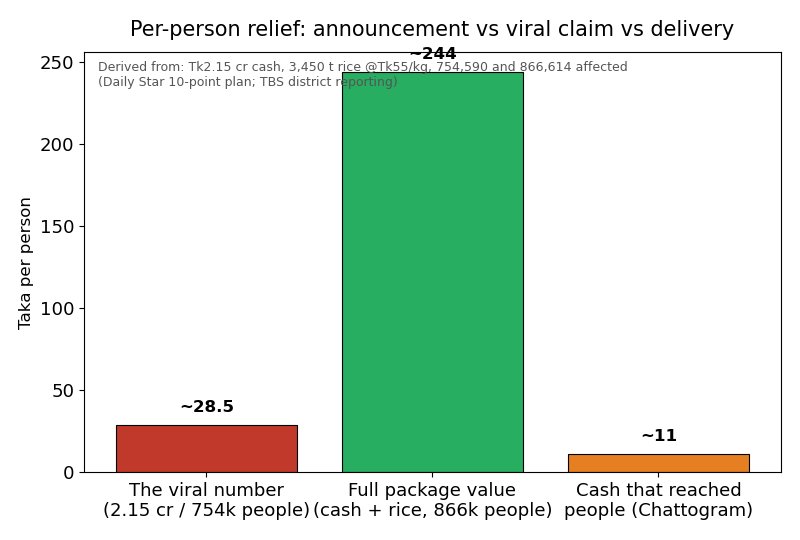
Divide the one by the other and you get twenty-eight and a half taka. There it is. The number is not invented. It is not propaganda in the narrow sense of being false. Somebody took a real allocation and a real population and did the division, and the calculator gave them twenty-eight.
The trouble is that the top and the bottom are describing two different maps. The two crore fifteen lakh in cash was meant to cover five districts, not one. The seven hundred and fifty-four thousand people are the count for one of those districts alone. And when the number travelled, it did not travel attached to Chattogram. It travelled attached to the biggest, roundest headline available, the one that said eleven lakh people, eleven hundred thousand, across ten districts. That sentence cannot be built from a single set of books. The twenty-eight needs the small denominator. The eleven lakh is the large one. You have to hold two incompatible maps in the same hand to make the sentence work, and most people never noticed they were doing it.
Swap the denominator to the five districts the cash was actually for, 866,614 people (government disaster summary, 11 July: Chattogram 662,000; Cox's Bazar 158,027; Khagrachhari 34,417; Rangamati 3,820; Bandarban 8,350, per The Business Standard), and the cash figure falls to under twenty-five taka. Stretch it across all ten districts in the headline and it drops toward nineteen. The number was never one number. It was a dial, and the person holding it had turned it to the setting that hurt the most.
The rice the number forgets
There is a second problem, and it is bigger than the denominator. Cash was not the whole package. Alongside the two crore fifteen lakh in money, the government released three thousand four hundred and fifty tonnes of rice (The Daily Star). Rice is harder to put in a caption than money, because you have to decide what a kilogram is worth before you can add it to anything. But you cannot simply leave it out, because for a family that has lost its kitchen, a sack of rice is not a rounding error. It is dinner.
Coarse rice in Bangladesh that month sold for roughly fifty taka a kilogram in Dhaka retail, up from forty-eight (The Daily Star, 20 July 2026), with Chattogram retail running Tk55 to 60 for Swarna Mota coarse (The Business Standard). To be fair to the question rather than to my own conclusion, I ran the valuation at fifty and at sixty as well, the honest edges of the market. Even at the low end the answer barely moves, and that is the point. At fifty-five taka, three thousand four hundred and fifty tonnes is worth eighteen crore ninety-eight lakh taka. That is nearly nine times the cash. The rice was the substance of the relief, and it is precisely the part the viral number deletes.
Put the cash and the rice together and the total value of the package comes to 21.13 crore taka, about one and three-quarter million dollars at 123.2 taka to the dollar. Spread across the 866,614 people the aid was actually for, that is about two hundred and forty-four taka a person, or getting on for eight hundred taka for a family. Two hundred taka is still not much to lose a house over. But two hundred taka and twenty-eight taka are not the same story, and only one of them was allowed to trend.
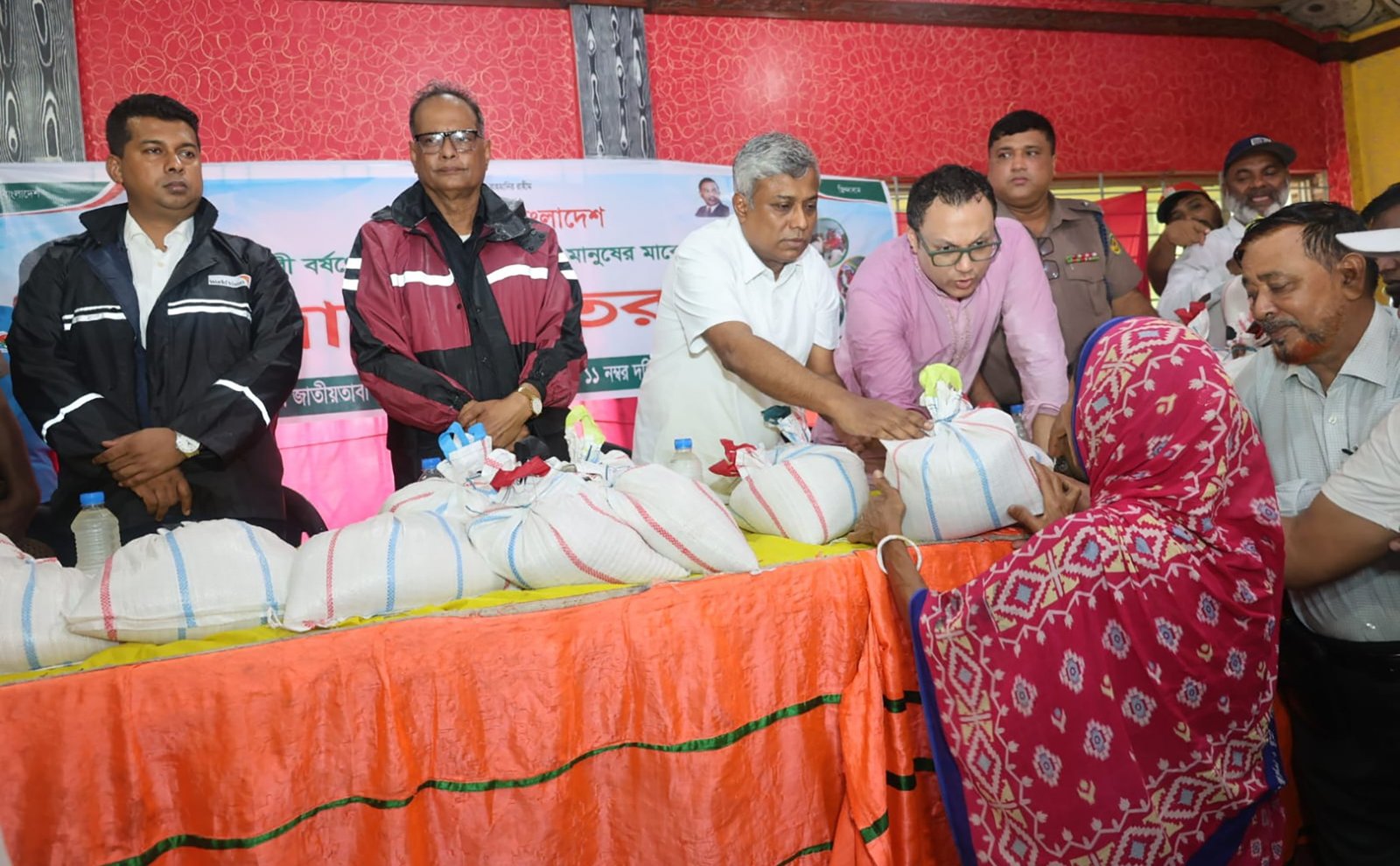
The gap between a promise and a plate of food
And yet. If the story ended with "the number is misleading, the government did more than it looked like," it would be a comfortable lie of a different kind. Because there is a third number, and it is the one that should have gone viral.
What a government announces, what it releases, and what actually reaches a wet, hungry person standing in a queue are three different things, and the distance between them is where relief goes to die. The announcement was two crore fifteen lakh in cash for the region. But when reporters from The Business Standard went and checked what had physically arrived for the 754,590 flood victims in Chattogram, the figure they could account for was about eighty-five lakh taka, twenty lakh of it from the Prime Minister's Relief Fund and sixty-five lakh from the Disaster Management and Relief ministry, with another seven hundred tonnes of rice. Framed against the days that had passed, that worked out to about eleven taka per person. Not per person announced. Per person reached.
In one upazila, Banshkhali, the reporting was starker still: residents claimed nearly eighty percent of affected families had yet to receive any government assistance despite remaining stranded for days (The Business Standard). I want to be careful here, because it would be easy to take that eighty percent and paint the whole country with it, and that would be its own kind of dishonesty. Banshkhali is one place. It is not a national average, and I am not offering it as one. But it is a real place where real people waited days for help that had, on paper, already been sent. The failure it describes is a failure of delivery, of roads and boats and lists and will, and it is exactly the kind of failure that a slogan about twenty-eight taka points at without quite naming.
So here is the fair verdict on the viral number, both halves of it held at once. As a piece of arithmetic dressed up as a fact, it is misleading. It uses cash without rice, borrows one district's victims to shrink a five-district budget, and treats a line in a ministry announcement as if it were food on a plate. But as a howl about a relief effort that was slow, thin, and unevenly delivered, it is fair. The people repeating it were wrong about the math and right about their lives. Both things are true. Refusing to say both is how you end up serving one team or the other instead of the reader.
The number nobody was talking about
Now turn the table over. While the argument raged over two crore fifteen lakh taka, there was another figure attached to these same districts. Not two crore. One thousand nine hundred and nine crore taka. Around a hundred and fifty-five million dollars at the same exchange rate. Nearly nine hundred times the relief pot people were fighting about.
That money had a name and a purpose. It belonged to a World Bank-financed project, the Bangladesh Sustainable Recovery, Emergency Preparedness and Response Project, shorthand B-STRONG, built to rebuild rural infrastructure and flood-protection systems across the Chattogram division, following the 2024 floods. ECNEC approved it on 20 April 2025. Of the Tk1,909 crore, the World Bank finances Tk1,647 crore and the government the rest (The Business Standard). It was, in other words, flood-prevention money for the very ground now underwater.
And it was already in trouble before the rain. On 29 April 2025 the Anti-Corruption Commission's Enforcement Team raided LGED headquarters in Agargaon after finding abnormally high prices set for project items before the work had properly begun: street solar lights priced at Tk72,000 each against the Planning Commission's view they were unnecessary, four laptops at Tk11 lakh, sixty motorcycles proposed against a Planning Commission suggestion of thirty-six (The Business Standard). I have to be precise about two things here, because precision is the only thing that keeps a comparison like this from becoming a smear.
The first is timing and responsibility. Those procurement events and that investigation belong to the interim administration that governed before the current elected government took office. It would be dishonest to quietly slide a 2025 finding under a 2026 administration because the visuals line up. The relief in July 2026 and the procurement flagged in April 2025 sit under different governments, and I am keeping them under different governments.
The second is causation, and it matters even more. I am not claiming that corruption in this fund caused this flood, or that a clean project would have kept these districts dry. Large infrastructure is slow. A prevention scheme can be incomplete for a hundred honest reasons, and an investigation into pricing is not a verdict that the works failed or that anyone has been convicted of anything. The Anti-Corruption Commission opened a matter; it has not, as far as the record shows, closed one. Treat it as an open question, not a proven crime. Nothing here should be read as a finding that any individual has committed a crime.
What I am willing to say is narrower, and I think it holds. The comparison between the relief pot and the prevention fund is not a comparison of like budgets, and I am not pretending it is. Emergency relief and long-term infrastructure are different instruments with different timelines. The reason to set them side by side is not that they are the same kind of money. It is that they are the same public's money, exposed to the same public's risk, in the same districts, in the same disaster. One of those exposures is small, visible, and the subject of a national argument. The other is enormous, concerns the prevention of the disaster itself, carries an open corruption question, and was barely mentioned. When a country spends its outrage almost entirely on the smaller, more visible sum, it is worth asking whether attention has landed where the money, and the risk, actually is.
Why the small number won
There is a reason the twenty-eight taka story travelled and the nineteen-hundred-crore story did not, and it is not mysterious. Twenty-eight taka fits on a card. It is small enough to feel personally insulting, concrete enough to picture, and it names a villain everyone already had in mind. Nineteen hundred crore is abstract. It lives in procurement documents and World Bank annexes. Its alleged wrong is a pricing spreadsheet, not a hungry child. It happened over years, under a previous administration, in a language of tenders and variation orders that is designed, sometimes on purpose, to be boring. Outrage is a muscle that reaches for the nearest handle, and the nearest handle was twenty-eight.
It did not help that this all played out on a sharply divided field. The governing party, the BNP, and Prime Minister Tarique Rahman were the heaviest targets of organized disinformation in the country during the first half of 2026. Dismislab documented the prime minister as the single most-targeted individual, with 78 false claims, and the BNP as the second-most-targeted party with 212 cases (The Daily Star). The BNP absorbed the heaviest overall assault of any party, with 47 AI-generated attacks alone (Global Voices), and Insights Bangladesh logged 2,402 fact-checked misinformation cases in January through April 2026. That does not make every criticism of the government a plant, and it would be lazy and convenient to say so. Much of the anger over the relief was plainly organic, rooted in the very real experience of waiting days for help that never came. Reporters who went to Banshkhali quoted named residents describing exactly that (The Daily Star). But a genuine grievance and a manufactured campaign are not mutually exclusive. A true story about slow relief is exactly the vehicle a bad-faith actor would choose, because it does not need to be faked to be steered. Both can ride the same number at the same time. The honest reader holds that ambiguity instead of resolving it in favour of whichever side they already prefer.
What the receipts actually say
Strip away the framing and here is what survives contact with the documents.
The viral figure is arithmetically reproducible and interpretively misleading. It exists. You can rebuild it from real numbers. And it only stands up if you use cash without the rice that was nine times its size, borrow one district's victims to divide a five-district budget, and mistake an announcement for a delivery.
The grievance underneath the figure is fair. Relief was thin, it was slow, and in at least some places it did not arrive. Measured by what people could actually be shown to have received rather than by what was announced, the help amounted to about eleven taka per person in the days that mattered most (The Business Standard).
And the largest financial exposure in this whole affair was never the relief at all. It was a prevention fund almost nine hundred times bigger, meant to spare these districts this exact fate, carrying an open corruption finding from a previous administration, discussed by almost no one.
None of these three statements requires you to love or hate the government to accept it. That is the test I hold them to. The first is a matter of division you can check yourself. The second is a matter of counting what reached people. The third is a matter of reading past the loudest number to the biggest one.
The habit worth keeping
I keep returning to the same small, stubborn thought. The country was not wrong to be angry. It was, for a while, angry with great precision at the wrong scale.
That is not a scolding. It is the most natural thing in the world. A relief figure you can hold in your hand will always beat a prevention figure buried in a procurement file, the same way a picked pocket feels worse in the moment than a slow leak in the roof, even when the roof will cost you the house. The people who design the framing of a scandal, whoever they are and whatever they want, understand this perfectly. They count on the eye going to the small, sharp, nearby number.
So the discipline I would ask for, of myself first, is boring and it is this. When a number goes viral, do the division yourself. Ask what is on top and what is on the bottom, and whether they come from the same map. Ask what was left out because it was harder to picture, like a warehouse of rice. Ask whether you are looking at what was promised or what arrived. And then, before you spend the last of your attention, ask the quiet question the loud number is so good at drowning out: is this the biggest amount of my money at risk in this story, or just the easiest one to see?
In July 2026, the answer in Bangladesh was twenty-eight taka on the surface and nineteen hundred crore underneath. Most of the shouting went to the surface. The water, and the money, were somewhere else.
A note on method, for anyone who wants to check my work
Figures here are drawn from government relief announcements, district damage tallies, wire and newspaper reporting citing named officials, market prices for rice, and multilateral and anti-corruption records, converted throughout at one US dollar to one hundred and twenty-three point two taka, the market rate for the week of the seventh to the thirteenth of July 2026. Where a source reports an allocation, I have said allocation and not delivery, and I have tried to keep the same discipline for the prevention fund, distinguishing what was approved and contracted from what was ever proven spent or completed. The rice was valued at fifty-five taka a kilogram, tested at fifty and sixty, with no meaningful change to the conclusion. Deaths, homes, and hectares are point-in-time counts as of the eighteenth of July 2026 and will move as the water recedes and the accounting improves. Where a claim rests on a single locality, such as the eighty-percent figure for Banshkhali, I have kept it to that locality and resisted turning it into a national number. Nothing here should be read as a finding that any individual has committed a crime; the corruption matter described remains an open investigation opened under a previous administration, not an adjudicated verdict.
Dated 21 September 2026
The original Substack post reported fifty-seven deaths (Cox's Bazar 32, Chattogram 15, Bandarban 6, Rangamati 3, Moulvibazar 1), per the Ministry of Disaster Management and Relief update of 15 July 2026 (UNB/New Age). By the date of publication, the government had reported the toll at 58, with Bandarban's count rising to seven (Financial Express, carrying a government statement, circa 16 July 2026). This draft uses the updated figure. A UN Situation Report dated 23 July 2026 later put the final count at 59. A second wording change: the original said the 412.3mm single-day rainfall was "the heaviest single day in more than four decades"; sources split between 42 years (New Age/UNB) and 43 years (The Business Standard, Prothom Alo), and the draft cites the range.