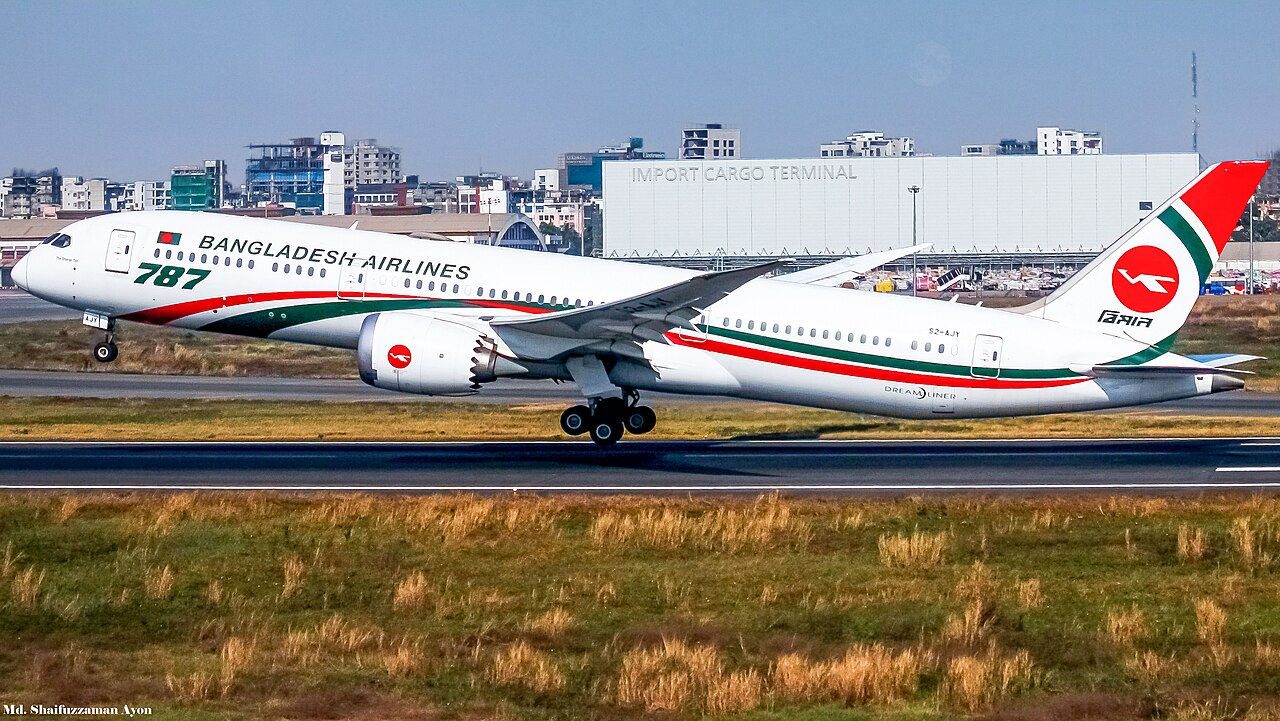
Update, 23 Sep 2026. After this article was published, Biman signed the New York agreement for 11 additional Boeing aircraft, taking its planned Boeing orders to 25. Reuters reports the signing took place in New York on 23 September, with models, prices, financing and delivery schedule undisclosed; the US Ambassador to Bangladesh, Brent Christensen, confirmed the purchase as a "win-win" for US-Bangladesh relations. The 10-aircraft Airbus proposal remains under negotiation. The figures below are updated to reflect the signing.
On 22 September 2026, the French ambassador to Bangladesh told a room of diplomatic correspondents in Dhaka that Biman Bangladesh Airlines had chosen Airbus for technical reasons, not for political reasons. It is the kind of sentence that only gets said about decisions that were political. Nobody holds a press event to announce that a procurement was boring.
Biman currently flies 19 aircraft. It now has 25 Boeings on order: 14 signed in April for $3.7 billion, plus 11 more signed in New York on 23 September, on top of a reported 10-aircraft Airbus proposal still under negotiation. The fleet would nearly triple on paper. The question nobody in the announcements answers is the one a former insider put plainly this week: what will Biman do with so many aircraft?
The ledger
Three years of the Biman widebody contest, in sequence:
| When | What happened |
|---|---|
| 2023 | The Awami League government announces a plan to buy 10 Airbus aircraft. French President Emmanuel Macron visits Dhaka and lobbies for the European manufacturer. A Bangladesh-UK joint statement references a possible Airbus purchase. |
| 30 Jan 2024 (reported) | Biman's techno-financial evaluation committee finds Airbus's offer for two A350-900s not financially viable: net present value negative over 25 years, with the two aircraft projected to cost about $900 million by June 2027 against a $763.75 million base price. |
| 9 Feb 2026 | The interim government signs the Agreement on Reciprocal Trade with the United States in Washington, three days before the national election. The US tariff demand of 37 percent is negotiated down to 20 percent, then 19 percent. Buying Boeing is part of the package. |
| 22 Apr 2024 | A reconstituted appraisal committee takes over the Airbus evaluation and concludes in three days that the deal is profitable, on revised cabin-factor and fuel-cost assumptions. |
| 30 Apr 2026 | Biman signs a $3.7 billion agreement with Boeing for 14 aircraft: eight 787-10 Dreamliners, two 787-9s, four 737 MAX 8s. Financing comes from the US Export-Import Bank. Deliveries run November 2031 to October 2035. |
| 17 May 2026 | Airbus submits a revised proposal: four A350-900 widebodies and six A321neo narrowbodies, down from an earlier 14-aircraft offer. |
| Aug 2026 | The government's reported 31 August signing target for the Airbus deal is missed; negotiations continue over aircraft mix, prices and commercial terms. |
| 16 Sep 2026 | The Daily Star reports Biman is preparing agreements for 21 additional aircraft: 11 Boeing jets and 10 Airbus planes. |
| 22 Sep 2026 | Ambassador Jean-Marc Séré-Charlet says negotiations are ongoing, the choice was technical not political, and France expects a fair and level playing field for European companies in Bangladesh. |
| 23 Sep 2026 | Biman signs the New York agreement for 11 additional Boeing aircraft, taking its planned Boeing orders to 25. Models, prices, financing and delivery schedule are not disclosed. |
Read the left column as governments and the right column as aircraft. The pattern is not subtle.
The three-day reversal
Correction, 23 Sep 2026. The original version of this article dated the evaluation committee reports to 2026. They are from 2024: the first committee reported on 30 January 2024, the second on 25 April 2024. The dates and details below are corrected.
This is the forensic flag in the story. Formed by Biman office order on 31 July 2023, the techno-financial evaluation committee reported on 30 January 2024 that two A350-900s were not financially viable over 25 years: net present value negative, revenue low because of poor yield, and heavy setup costs for a dissimilar two-aircraft fleet (spare engines, parts, tools, crew training). The base price was $763.75 million, but with 5.50 percent SOFR interest and Airbus's escalation formula, Biman projected paying $900 million by June 2027, and over $1 billion all in. The report's own escape clause said funding at less than 1 percent interest might make the project viable.
On 22 April 2024 a reconstituted committee took over and reported on 25 April 2024 that the deal was profitable. The reversal came from changed inputs: cabin factors as high as 92 percent that Biman had never achieved (its actual average was around 76 percent), and a lower jet fuel cost assumption. On the same Dhaka-New York and Dhaka-Jeddah routes, the first committee projected a $188.37 million loss over 25 years; the second projected a $135.34 million profit. The board then gave the go-ahead for four Airbus aircraft at about $180 million each.
Accounts differ on how the committee changed. The Daily Star's May 2024 reporting says the board reconstituted the committee, replacing the engineering director who headed the first. The outgoing managing director, Shafiul Azim, later said the committee did not change, the previous head retired, and Airbus submitted a revised proposal that was "much better." The full report was never released, though TBS News and The Daily Star obtained and quoted it at length. Note what the 2024 escape clause means against the 2026 picture: the financing now on the table is export-credit-agency support. In June 2025 Airbus told the chief adviser 85 percent of the funding could come through ECA financing, and in September 2026 the French envoy said the export credit agencies of all four Airbus partner countries had expressed interest in the deal. Sub-one-percent money is exactly what the first committee said would flip its verdict. That connection is plausible but unproven, and it is the thread everything else hangs on: a viability finding that flips in three days is how a predetermined decision gets its paperwork.
The Boeing half
The $3.7 billion Boeing deal is the one with a published price, a published financier, and a published motive. It was part of the interim government's strategy to cut the US tariff and narrow the trade deficit. During the negotiations Dhaka had signalled plans for as many as 25 Boeing aircraft; the final number was 14. The Daily Star's own editorial, published the day of the signing, read it straight: a large financial obligation taken on by an unelected government, concluded without parliamentary scrutiny, for the next administration to inherit. Deliveries do not even begin until November 2031 and run to October 2035. This is a decade-long commitment financed by US export credit, signed in the last days of an interim setup.
The Airbus half
The Airbus half has no published price. An Airbus spokesperson told TBS News the company cannot make the price public because of legal obligations, but the customer may disclose it after an agreement is signed. For scale only: the A350-900 carried a list price of $317.4 million in late 2023 and the A320neo $110.6 million, per aviation press. Airlines never pay list, so those numbers tell you the order of magnitude and nothing about the deal. The real number is unknown, which means the public cannot do the one calculation that matters: cost per aircraft against the Boeing package's headline $264 million. The government's reported 31 August 2026 signing target was missed, and as of late September the two sides are still negotiating aircraft mix, prices and commercial terms. Separately, on 23 September Biman signed the New York agreement for 11 more Boeing aircraft, taking its planned Boeing orders to 25, per Reuters; the models, prices, financing and delivery schedule were not disclosed.
The technical case for a mixed fleet is real and was made on the record by people with no aircraft to sell. Former Civil Aviation Authority chairman M Mafidur Rahman supports it: relying on a single manufacturer leaves an airline exposed if one maker's aircraft hit technical or regulatory trouble. He also stated the cost honestly: two manufacturers means higher maintenance bills, more training, more technical complexity. The outgoing MD added the commercial argument: fleet diversity gives passengers a choice of aircraft. None of that is disputed. What is missing is the price at which the diversity is being bought.
The arithmetic
Set the diplomacy aside and count metal. Biman flies 19 aircraft today. The April Boeing agreement put 14 on order. The 23 September New York signing put 11 more on order, bringing confirmed Boeing orders to 25. A 10-aircraft Airbus proposal remains under negotiation. If all of it closes, the flag carrier holds 35 aircraft on order against 19 flying, the largest expansion in its history.
An aircraft becomes an economic asset only when it flies productively. Each additional plane needs pilots and cabin crew, engineers, maintenance facilities, spare parts, training, insurance, airport slots, and, above all, enough passengers and cargo to pay for itself. A new aircraft that spends its time on the ground is not cheaper for being new. It is an expensive idle asset. That is the insider's warning from the TBS analysis this week, and it is the only question in this story that is about aviation rather than diplomacy: where do 35 aircraft go?
Part of the answer is the government's stated ambition: direct Dhaka-New York flights, a regional aviation hub, an aviation master plan under formulation, a new air traffic management system at Hazrat Shahjalal International Airport. Ambitions are not routes. The New York route needs US Federal Aviation Administration Category 1 safety status first, and the minister has said so himself.
This is not a fleet strategy. It is a diplomatic ledger being balanced in public. Airbus was the Awami League's purchase, deepening ties with Europe. Boeing was the interim government's purchase, buying tariff relief from Washington. Buying both is the elected government's purchase, so that nobody is owed. The French ambassador asking for a "fair and level playing field for European companies" is Paris collecting its receipt. The US ambassador's support for Bangladesh's aviation-hub aspirations is Washington holding its copy.
The business case for a mixed fleet may exist. The political logic is fully visible, and it is doing most of the work. The envoy's "technical reasons, not political reasons" is the tell: technical decisions do not need to deny being political.
What to watch
Three observables, stated so they can be proven wrong. First, the January committee report: if its text surfaces, compare its numbers line by line against the April reversal and see what actually changed. Second, the Airbus price and financing terms: the company says the customer may disclose after signing, so watch for the per-aircraft figure and the credit terms, and compare them against the Boeing package. Third, the terms of the 23 September deal: 11 more Boeings were signed with no published models, price, financing or delivery schedule, so watch for the per-aircraft figure and compare it against the April package's headline $264 million. Fourth, utilization: 35 aircraft on order against 19 flying means the delivery schedule and the route map have to exist somewhere. Watch whether they appear before the metal does.
Sources
- Reuters, "Bangladesh to buy 11 more Boeing jets as it seeks closer US trade ties," 23 Sep 2026 (New York signing; US Ambassador to Bangladesh Brent Christensen's "win-win" confirmation).
- The Daily Star, "Talks on Biman-Airbus deal still ongoing: French envoy," 22 Sep 2026.
- The Daily Star, 16 Sep 2026 reporting on Biman's planned 21 additional aircraft (11 Boeing, 10 Airbus).
- The Daily Star, "Airbus submits fresh 10-aircraft proposal to Biman," 17 May 2026.
- The Daily Star, "Airbus makes fresh pitch after Biman-Boeing deal," May 2026.
- The Daily Star editorial, "Boeing deal reflects geopolitics more than aviation strategy," 30 Apr 2026.
- TBS News, "What will Biman do with so many aircraft?" 21 Sep 2026.
- TBS News, "Biman also to buy 10 Airbus aircraft in fresh multibillion-dollar deal," Jul 2026.
- TBS News, "Biman proceeding with Airbus deal to avoid future risks: Outgoing MD," Jun 2026.
- TBS News, "Airbus not viable financially, Biman evaluation finds," quoting the full January 2024 committee report, Feb 2024.
- The Daily Star, "Biman U-turns to buy Airbus planes," on the April 2024 three-day reversal, 28 May 2024.
- Industry Insider BD, "Biman-Airbus deal remains under negotiation," 23 Aug 2026 (missed 31 August signing target).
- Financial Express, on the export credit agencies of the four Airbus partner countries expressing interest, 22 Sep 2026.
- Financial Express, "Biman set to sign deal for 11 more Boeing aircraft in NY," 22 Sep 2026.
- The Wire, "Biman Drops Airbus, Buys Boeing: What Bangladesh's Air Deal Says About Its Strategic Priorities," May 2026.
- Dj's Aviation, "Controversial Airbus Order To Be Finalised," Aug 2026.
- BDJam / The Current View, on the April 30 Boeing agreement terms and the Dhaka-New York ambition, Sep 2026.