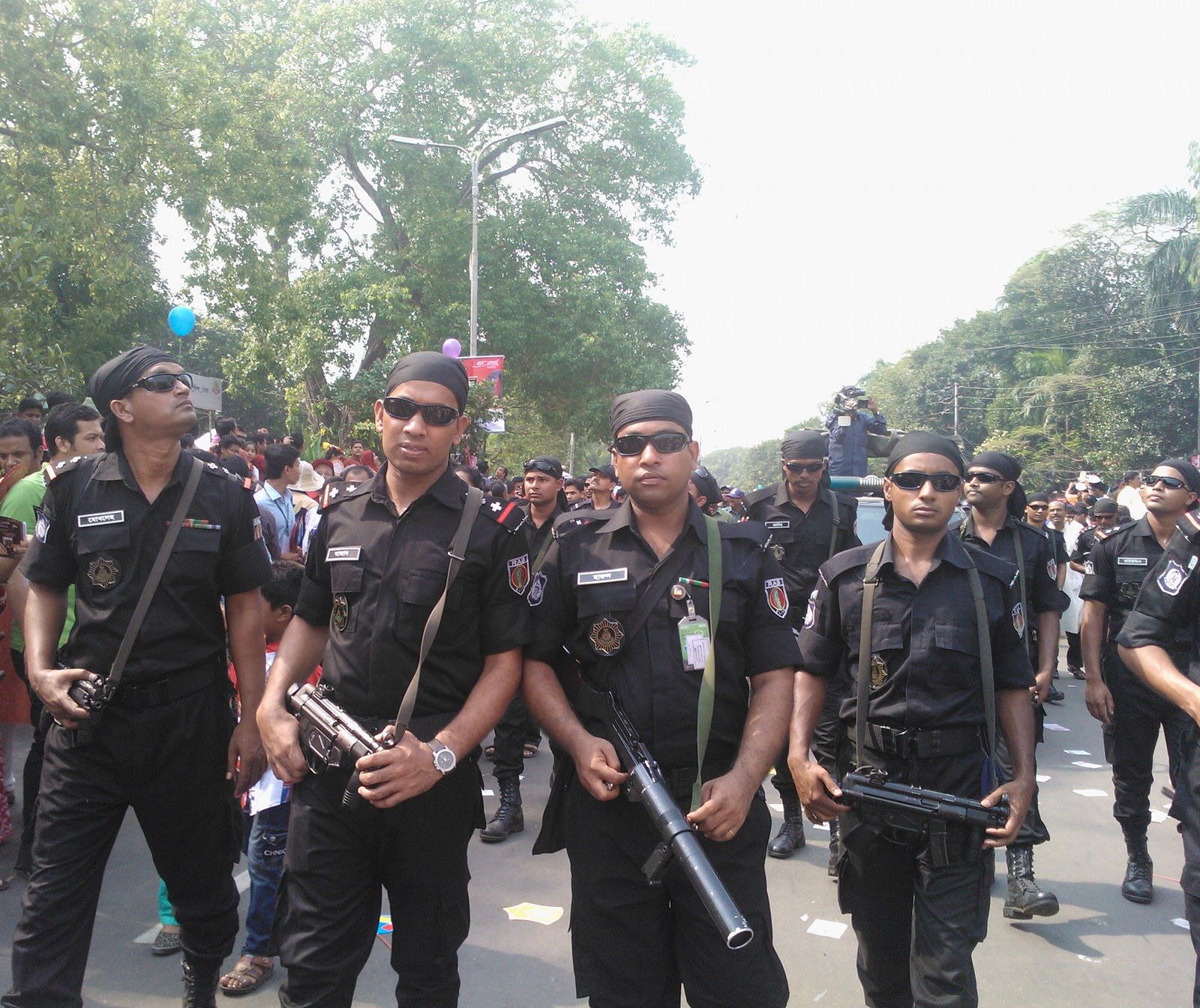
Two national dailies reported this week that the government is considering a nationwide security operation modeled on the 2002 Operation Clean Heart, nearly 24 years after the original. Jugantor's September 30 front page put the plan at the preliminary discussion stage, quoting an unnamed Home Ministry source. Samakal's September 29 front page carried the same consideration, built on the same kind of unnamed sourcing. No minister, no ministry spokesperson, and no police headquarters statement has confirmed that any plan exists. What is reported is a discussion, not a decision.
Two dailies, one unnamed source pool
Jugantor's story, headlined "'অপারেশন ক্লিন হার্টের' আদলে অভিযানের চিন্তা," says the plan is still at the preliminary discussion stage, and that a formal decision would require a high-level government meeting. The on-record quotes inside the piece come from established figures: DMP Commissioner Mosleh Uddin Ahmed said investigations are ongoing against those involved and the instigators, and that joint drives by uniformed police and the Detective Branch will be intensified; former IGP Nurul Huda said specific information has already emerged on who is behind the incidents and why, and that pulling the behind-the-scenes figures could bring the situation to tolerable levels; Police Headquarters AIG (Media) AHM Shahadat Hossain said police have intensified intelligence surveillance, patrols, and checkpoints. The unnamed Home Ministry source added that there is no alternative to a joint operation, citing intelligence reports on top-terrorist backing and internal conflicts behind recent attacks, and an effort to destabilize the country and embarrass the government. Jugantor, September 30
Samakal's September 29 front page, "মাদক, কিশোর গ্যাং চাঁদাবাজ দমনে 'ভিন্ন' অভিযানের চিন্তা," independently reports the same consideration: formal and informal meetings at policymaking level in recent days, the 2002 operation kept as the example, disagreement over whether to give the operation a name or go nameless, a top-level green signal needed before guidelines follow, and a possible next meeting this week. MZamin print-edition roundup, September 30
Both accounts rest on unnamed sources, and they could reflect the same briefing rather than two independent confirmations. No outlet contradicts the claim; none confirms it either. Daily Songbad Diganta reported September 30 that no government operation has been announced under any name.
A note on sourcing: the material shared with this newsroom named Independent TV and Jugantor as the channels. No Independent TV web report on this story was found; it may be a broadcast-only segment. This piece treats the claim as resting on the two print dailies, and does not count the Independent TV mention as a sourced claim.
Four incidents in 47 hours
Jugantor names four Dhaka incidents as the trigger. Samakal anchors its timeline with the Comilla murder of class-7 student Ishayat Shahriar Apratim, abducted September 18 with his body found September 19 in the Lalmai hills in a teen-gang-linked case, followed by a 47-hour cluster of four Dhaka attacks beginning the midnight of September 24.
At Chand Udyan in Mohammadpur on the morning of September 26, 150 to 200 people led by two men named Joni and Rezaul attacked and vandalized a 17-katha plot with boundary walls and tin structures. The owner, Md. Alam, has been abroad since August 5, 2024. Mohammadpur police station OC Abdul Halim confirmed the attack on the record; no case had been filed as of the evening of September 26. Three outlets carried it the same day: Jugantor, TBS Bangla, Samakal.
At Shyamoli Housing in Adabor on September 26 around 6:30 in the morning, 15 to 20 masked men led by Khurshid Alam Khan attacked plots 41 and 42 on road 6 with local weapons and firearms, breaking the main gate, CCTV cameras, and windows. The group had occupied the building for about a year and a half; in March 2026 police arrested some of the occupiers and returned possession to the owner, businessman Aminur Rahman Khan. A case filed September 28 names Khurshid Alam Khan and seven others plus 15 to 20 unknown people. On September 29 the DMP announced 10 arrests: Rajib Hawlader, Sagar alias Chhoto Bigar, Shakib, and Rashed were picked up around 2 AM near Naboday Housing; Rajib and Sagar were shot in the leg by police in what police described as self-defense; chapati, samurai swords, and kiris were seized. Adabor OC Zahidul Islam said on the record that the arrested men took money to join the vandalism. Bangla Tribune, September 29; Dhaka Tribune Bangla, September 28.
At New Guinea Properties near ECB Chattar on the night of September 26, an attack, vandalism, and looting hit the developer's site. Jugantor attributes the root cause to a long dispute between retired Brigadier General Golam Mohiuddin Chowdhury and the owner, Nazim Uddin Bhuiyan. Nazim told Jugantor he was previously Jamaat-linked, joined Awami politics under the AL government, and rejoined Jamaat after the August 2024 uprising; that he rented a room to July-fighter and content creator Salman Muktadir about a year and a half ago; and that he received phone threats from a man named Sohel, who identified himself as the shooter of fugitive top terrorist Shahadat Hossain, before the attack. Here is where reporting thins to a single chain: an unnamed investigation source told Jugantor that Chowdhury contacted the fugitive Awami-leaning top terrorist Shahadat Hossain, who sent more than 200 armed cadres led by the shooter Sohel, and that a planned campaign then framed the attack as "BNP/Youth Dal extortion" on Facebook Live and in the media. That is the most explosive claim in the package and the least corroborated: no FIR, no charge sheet, and no second outlet confirms the Shahadat-Chowdhury link.
At Radda in Mirpur in the midnight hours of September 24, 200 to 250 people attacked a charitable trust that has operated since 1974 on nominally Bihari-owned land. Prothom Alo reported September 29 that Hanif Mia and former Dhaka City Jubo Dal leader Mostafa Jaglul Pasha allegedly directed the attack from a white microbus; that claim was not independently verified in this pass.
Jugantor reports a law-enforcement belief that the old tactic of using top terrorists for land grabs and dominance has not changed despite the change of power, with political shelter and old grudges exploited. Separately, Desh Rupantor's front page reported teen gangs backed by ruling-party leaders, a police special-unit's secret message to the high command, and Transparency International Bangladesh expressing deep concern.
What happened the last time
Operation Clean Heart ran from October 16, 2002 to January 9, 2003, eighty-five days. It was ordered by Prime Minister Khaleda Zia's BNP-led government and executed by joint forces: the Army, Navy, BDR, Police, and Ansar. The Daily Star's record puts the deployment at roughly 40,000 personnel, about 24,023 army and 339 navy, plus BDR, police, and Ansar. The operation produced 11,245 arrests, including about 2,482 listed criminals, and recovered 2,028 firearms and 29,754 rounds.
The custodial-death count varies by source: 44 in the Daily Star's news reporting, around 57 in its editorial, 60 per Human Rights Watch, and 12 per the then-government, which attributed them to heart attacks. Amnesty International and the Asian Human Rights Commission alleged extrajudicial killings and torture during the operation. Daily Star; Daily Star editorial; Amnesty International; Asian Human Rights Commission.
The legal aftermath defines the precedent. The Joint Drive Indemnity Ordinance was promulgated on January 9, 2003, hours before the operation ended, and enacted as law on February 24, 2003. In 2015 the High Court scrapped it as illegal and unconstitutional, ruling that victims could seek compensation and file cases. bdnews24. The BBC's 2002 reporting, recounted by Channel i Online in September 2026, noted that details of the operation were known only to the prime minister and a few senior ministers; that homes of politicians across parties were searched; and that Law Minister Moudud Ahmed later wrote that custodial deaths ran to 40 to 65 and that most of the criminals picked up were BNP men, which generated pressure inside the party to withdraw the army. Channel i Online. Former Army chief Iqbal Karim Bhuiyan called the indemnity a "licence to kill" in ICT-1 testimony. The Rapid Action Battalion was created in 2004, in the operation's aftermath.
Why the context is different this time
The party that ordered the 2002 operation is the one now considering its successor. Tarique Rahman became the country's eleventh prime minister on February 17, 2026, after the BNP's landslide in the February 12 election, which gave the party 209 seats, replacing the Yunus interim government. The 2002 precedent's political costs, the intra-party blowback and the indemnity law that followed, are directly relevant to any repeat. Hindustan Times.
A nationwide crackdown already ran this year. A special anti-crime operation from May 1 to July 12, 2026 produced 32,908 arrests. A joint anti-crime drive of police, RAB, the Department of Narcotics Control, and intelligence agencies has run since May 1. On September 2 the RAB director general announced a nationwide special drive to recover firearms looted during the 2024 mass movement. New Age/BSS; BSS; BSS.
The government's stated guardrail is on the record. Home Minister Salahuddin Ahmed said September 30 that operations against terrorists, armed criminals, drug traders, and extortionists will be intensified and that police regularly update their lists. IGP Ali Hossain Fakir told field officers September 29 that a criminal's only identity is that he is a criminal, and that political identity must not shield anyone. The 2002 record, in which most detainees were the ruling party's own men, is the counterweight to that line. One outlet quoted the minister using the phrase "Operation Clean Hunt," which may be a typo or a distinct working name; the wording is unverified and this piece does not adopt it.
What remains unknown
Three gaps carry the story's weight. First, the planning claim rests on one unnamed source. Jugantor's "considering an operation" and Samakal's "thinking of a different operation" could reflect the same briefing, not two independent confirmations. Until a second independent chain or an on-record confirmation appears, "reportedly" does the load-bearing work, and this article cannot treat the operation as decided.
Second, the orchestration narrative is single-chain. The Shahadat Hossain connection, the 200-plus armed cadres, and the staged "BNP/Youth Dal extortion" framing come only from Jugantor's unnamed investigation source. The political-framing allegation is the most explosive claim in the package and the least corroborated.
Third, nothing about scope exists. Samakal reports that even the naming is undecided. There is no draft guideline, no announced force composition (an army role is unconfirmed), and no indemnity or legal-framework discussion on record. The 2002 operation's defining features were custodial deaths and a retroactive indemnity law later voided by the High Court; whether any new operation would repeat the joint-forces model or the legal immunity is entirely unaddressed. No rights body and no editorial board has gone on record about the proposal, so the accountability half of the story is currently empty.
Stated so they can be proven wrong: the story moves if a minister or police headquarters confirms a plan on the record; if a second outlet independently confirms the planning with its own sourcing; if the Shahadat-Chowdhury link appears in a case document; and if any rights body or editorial board publishes a position on the proposal.
Sources
- Jugantor, "'অপারেশন ক্লিন হার্টের' আদলে অভিযানের চিন্তা," front page, 30 Sep 2026.
- Samakal, "মাদক, কিশোর গ্যাং চাঁদাবাজ দমনে 'ভিন্ন' অভিযানের চিন্তা," front page, 29 Sep 2026 (via MZamin print roundup, 30 Sep 2026).
- Daily Songbad Diganta, "No government operation announced under any name," 30 Sep 2026.
- Jugantor, TBS Bangla, Samakal, Chand Udyan attack reports, 26 Sep 2026.
- Bangla Tribune, "Shyamoli Housing arrests," 29 Sep 2026; Dhaka Tribune Bangla, same case, 28 Sep 2026.
- Daily Star, "Operation Clean Heart indemnity law illegal: HC"; Daily Star editorial on the scrapped law; bdnews24, "HC scraps law giving indemnity for Operation Clean Heart."
- Channel i Online, recount of BBC's 2002 Operation Clean Heart reporting, ~20 Sep 2026.
- Amnesty International, "Bangladesh: Accountability needed: Operation Clean Heart," 2002; Asian Human Rights Commission, urgent appeal UA-52-2002.
- New Age/BSS, "Nearly 33,000 arrested in nationwide anti-crime crackdown," May-July 2026; BSS, joint anti-crime drive since May 1, 2026; BSS, RAB DG firearm-recovery drive, 2 Sep 2026.
- Hindustan Times, Tarique Rahman premiership, Feb 2026.