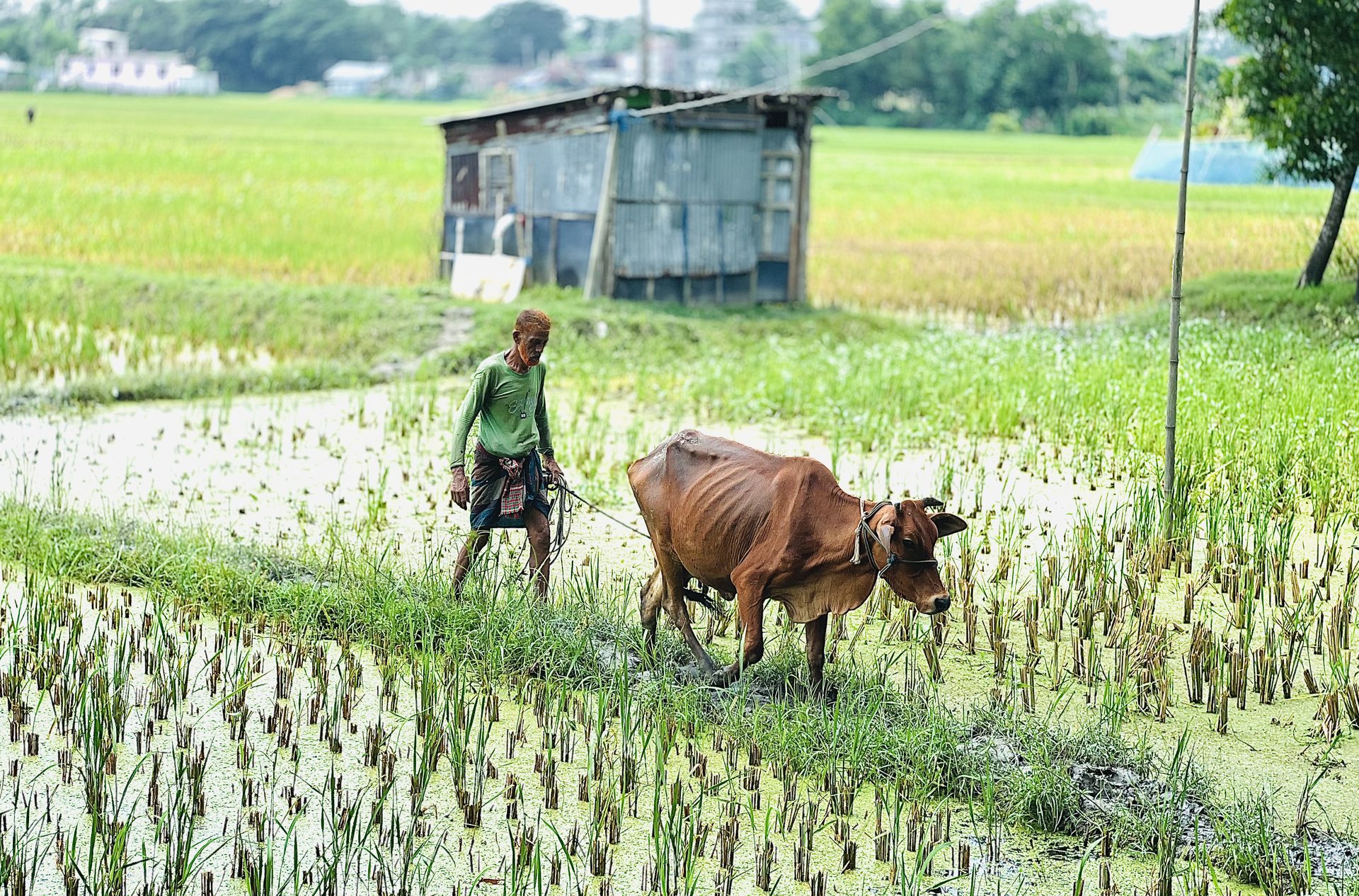
In September 2026, CNA's documentary unit asked a question that sounded like optimism: can Bangladesh grow enough food for 180 million people with less chemical fertiliser, now that a Middle East crisis and Strait of Hormuz disruptions are squeezing the country's fertiliser supply? The film tours the agricultural heartlands, a vermicompost farmer in Madhupur, a rooftop farmer in Dhaka, an organic-pesticide maker in Hatti village, native seed producers in Chattogram, and asks whether chemical-free food production is within reach.
The research behind this analysis says the question is half right. Bangladesh can almost certainly farm with less chemical fertiliser. The evidence, from Bangladeshi field trials and the government's own stated targets, supports a gradual reduction of 32 to 35 percent paired with organic inputs and balanced application. What the evidence does not support is the film's implied endpoint: going chemical-free. The country that tries that overnight has already been tried, and the result was a warning, not a blueprint.
The dependence, in numbers
Bangladesh applies roughly 6.6 million tonnes of chemical fertiliser a year. In FY2024/25, the four subsidised fertilisers broke down as 2.644 million tonnes of urea, 1.523 million tonnes of DAP, 1.013 million tonnes of MOP and 0.765 million tonnes of TSP, according to the US Department of Agriculture's Dhaka office (March 2026). Use intensity runs to 391 kilograms per hectare, nearly three times the global average, applied on 98 percent of the country's land, and almost entirely by estimation rather than soil testing, according to the Soil Resource Development Institute via Prothom Alo (January 2026).
Farmers typically overapply urea in rice and TSP and MOP in potato relative to the Department of Agricultural Extension's recommended doses. The Boro and Rabi season (December to April) consumes more than 70 percent of all chemical fertiliser, and Boro rice alone needs 3.0 to 3.2 million tonnes between December and May. The scale is what makes the supply question existential: the government has fixed retail prices for FY2025-26 at 27 taka per kilo of urea, 27 for TSP, 20 for DAP and 21 for MOP, which means every price spike in the international market lands on the state budget, not on the farmer.
The soil underneath
The heavier the application, the thinner the soil. The USDA's March 2026 assessment links overapplication to declining soil fertility, nutrient imbalances, reduced organic matter and diminished soil biodiversity, particularly in northern Bangladesh. SRDI's land-degradation work puts a number on it: roughly 75 to 76 percent of the country's land is degraded or nutrient-depleted, and organic matter is depleted on 78.7 percent of it. Good soil needs at least 2.5 percent organic matter; most Bangladeshi soil tests below 1.5 percent. Excess urea is driving rising soil acidity, for which the Bangladesh Agricultural University's remedy is a tonne of lime per hectare every three years.
The food-safety numbers are no better. More than 29 percent of 1,577 tested vegetable samples carried pesticide residues, with cucumber at 51 percent, tomato at 41 percent and cauliflower at 31 percent (Mahmud et al., Toxicant Research, 2025). About 27 percent of farmers experience pesticide-related health issues in a given year. The soil and the bodies absorbing the chemicals are telling the same story: the input-heavy model is consuming its own base.
The Hormuz lever
About 80 percent of Bangladesh's fertiliser demand is imported. MOP is 100 percent imported, from Russia, Belarus and Canada. Urea comes from the UAE, Saudi Arabia and Qatar. TSP comes from Morocco and Tunisia. DAP comes from China and Jordan. Roughly one third of all global fertiliser trade passes through the Strait of Hormuz, and 2026 has already forced shutdowns of domestic urea plants at Ghorashal Polash, Karnaphuli and Shahjalal on gas shortages, plus a halt at the DAP Fertilizer Company in Chattogram on ammonia shortage.
This is the real part of the CNA documentary's premise. The 2026 Middle East strain on Hormuz routes has genuinely squeezed fertiliser access, and the government is now planning 1.7 million tonnes of Aman-season imports while scouting alternative sources in Egypt, Latvia, Belarus, Brunei and Vietnam. A country that feeds 180 million people on imported inputs routed through one strait has a supply problem regardless of what it thinks about organic farming.
That arithmetic is the quiet engine behind the policy push: cutting chemical use is not only agronomy, it is fiscal survival.
The plan
The government's stated target is to cut chemical fertiliser use by 32 to 35 percent while scaling up organic use, announced by the agriculture secretary at an October 2025 roundtable with a proposed incentive of Tk5,000 per tonne of organic fertiliser. The agriculture minister said in February 2026 that organic farming would be introduced in the fertile char lands for export-oriented organic crops. The Department of Agricultural Extension is pushing vermicompost and tricho-compost, though the gap is stark: Manikganj district alone demands roughly 88,000 tonnes of chemical fertiliser against only 3,000 to 4,000 tonnes of local organic production.
The most concrete breakthrough is institutional. The Bangladesh Rice Research Institute's bio-organic fertiliser, made from vegetable waste, biochar, rock phosphate and beneficial bacteria, has been field-tested across the Boro, Aus and Aman seasons. Applied at 500 to 750 kilos per hectare, it fully replaces TSP and permits a 25 to 30 percent urea reduction with yields at parity with full chemical fertiliser. In February 2026, BRRI signed a technology-transfer agreement with ACI PLC for commercial national production. Meanwhile, the Bangladesh Agricultural Research Council's long-standing balanced-use guidance, soil-test-based dosing, urea deep placement, integrated nutrient management, is credited with the potential to lift yields 8 to 14 percent while saving up to Tk20,000 crore a year.
The trial evidence lines up behind the gradual path. Integrated nutrient management trials in Bangladesh, combining reduced chemical rates with rice straw, cowdung or poultry manure, improved T. Aman and Boro rice yields over 100 percent chemical fertiliser alone. Half the recommended dose plus 50 percent poultry manure or vermicompost delivered promising rice yields with better soil nitrogen, potassium, organic carbon and bulk density (Habiganj Agricultural University, December 2024). Seventy-five percent NPK plus biosolids raised rice productivity while cutting methane emissions (Haque et al., 2021). Reduced chemical doses paired with poultry manure, compost or biochar raised rice, maize and jute yields by up to 17 percent while improving soil and cutting input costs.
The warning
Sri Lanka is the case Bangladesh's policymakers keep naming, and for good reason. In April 2021, President Gotabaya Rajapaksa imposed an overnight nationwide ban on synthetic fertiliser and pesticide imports and use, ordering roughly two million farmers to go organic with no transition plan. Rice production fell about 20 percent within six months, with farmer-survey estimates as high as 53 percent average paddy yield loss. A formerly self-sufficient country imported $450 million of rice. Rice prices rose 50 percent. Tea production fell 16 to 18 percent with roughly $425 million in export losses. Food inflation peaked at 94.9 percent in September 2022. The ban was partially reversed within months.
The scholars who studied the failure attribute it to advisors with no expertise, no data on organic-fertiliser sourcing, no infrastructure, and no application plan (Springer, Food Security, 2025; Taylor and Francis, 2026). That is exactly the contrast with Bangladesh's approach: a gradual 32-to-35-percent reduction target, organic scale-up, balanced-use extension and monitoring, not an overnight ban. The lesson is not that reduction is impossible. It is that speed is the variable that kills.
Auditing the film's claims
Two of the documentary's claims deserve the forensic treatment. First, the narration that "Bangladesh is ranked fourth in terms of toxic food production due to excessive chemical spraying." No independent source for any such ranking exists. A 2024 peer-reviewed review instead ranks Bangladesh's pesticide use 29th globally. The residue contamination figures are real and bad; the "fourth" ranking is unverified and should be treated as the film's claim, not a fact.
Second, the framing itself: the film's journey toward "chemical-free food production" for 180 million people presents an endpoint that no cited expert evidence supports. The trials support reduced chemical use with organic integration, not elimination. The film is a human-interest documentary asking whether life without oil is possible, not a technical assessment. It should be watched as inspiration for the transition's first steps, not as evidence for its destination.
What to watch
Three observables, stated so they can be proven wrong. First, the 32-to-35-percent reduction target: if the agriculture ministry does not publish a dated roadmap with the promised registration and monitoring system, the target is a press statement, not a policy. Second, the BRRI-ACI bio-organic fertiliser rollout: national commercial production at meaningful volume is the first real test of whether organic substitution scales beyond demonstration plots. Third, the Aman-season import execution: the 1.7-million-tonne import plan is the near-term stress test of the Hormuz diversification strategy; any shortfall there will tell you more about food security this year than any documentary.
The thesis of this piece, in one line: Bangladesh does not need to choose between chemicals and hunger. It needs to use fewer chemicals, better, and the country that does that deliberately gets a stronger harvest. The country that does it overnight, as Sri Lanka proved, gets neither.
Sources
- CNA Insider, "Can Bangladesh Grow Enough Food With Less Chemical Fertiliser? | A Life Without Oil" (YouTube, circa 17 Sep 2026). CNA listing: "A Life Without Oil – Bangladesh Farming Crisis" (premiered 14 Sep 2026).
- CNA, "A Life Without Oil" series hub (premiered 12 Sep 2026): Pakistan's Solar Revolution, Bangladesh Farming Crisis, India's Biogas March, Philippines' Electric March.
- USDA FAS Dhaka, "Fertilizer Situation in Bangladesh," Report BG2025-0017, 30 Mar 2026.
- Prothom Alo English, "Soil fertility declining, food security under threat," Jan 2026 (SRDI intensity figures).
- Daily Star op-ed, "Fertiliser supply key to food security," 16 Apr 2026 (demand estimates, Hormuz trade share).
- Financial Express, "Govt to import 1.7m tonnes of fertilisers to ensure Aman season supply," Sep 2026.
- Financial Express, "BRRI, ACI sign MoU for technology transfer of BRRI organic fertiliser," 10 Feb 2026.
- Financial Express, "Eco-friendly farming methods evolving as viable alternatives," Sep 2026 (Manikganj figures).
- TBS News, "ActionAid, BARI call for national roadmap to promote organic fertiliser," 31 Oct 2025 (32–35% target, Tk5,000/tonne incentive).
- BSS News, "Organic farming to be introduced in char areas: agriculture minister," 22 Feb 2026.
- Daily Star, "Revised budget for FY25: Power, fertiliser subsidies to balloon," 15 Mar 2025 (Tk28,000 crore revised subsidy).
- Daily Star, "Fuel, fertiliser imports: Govt needs $2.61b extra until June," Apr 2026 (Tk97,542 crore projected bill).
- Daily Star, "The overlooked plight of our soil," 4 Dec 2022 (SRDI degradation figures).
- Bonik Barta English, "Bangladesh farmland faces twin threat of acidity and depleted soil quality" (SRDI nutrient breakdown).
- Mahmud et al., pesticide residues in vegetables, Toxicant Research, 2025 (29% contamination).
- Shake et al., "Uses and abuses of pesticides in Bangladesh," Ecology Journal 6(1), 2024 (pesticide-use ranking, 29th).
- Bangladesh Journal of Nuclear Agriculture, integrated plant nutrient system rice trials (cowdung treatment best).
- Habiganj Agricultural University, organic strategies in rice, Dec 2024 (50% dose + manure).
- Haque et al., 2021, via IRRI Rice Today (75% NPK + biosolids).
- Foreign Policy, "Sri Lanka's Organic Farming Experiment Went Catastrophically Wrong," 5 Mar 2022.
- Springer, Food Security, "On the feasibility of an agricultural revolution: Sri Lanka's ban of chemical fertilizers in 2021," 2025.
- Taylor & Francis, "The transition that wasn't: why Sri Lanka's organic farming approach failed," 2026.