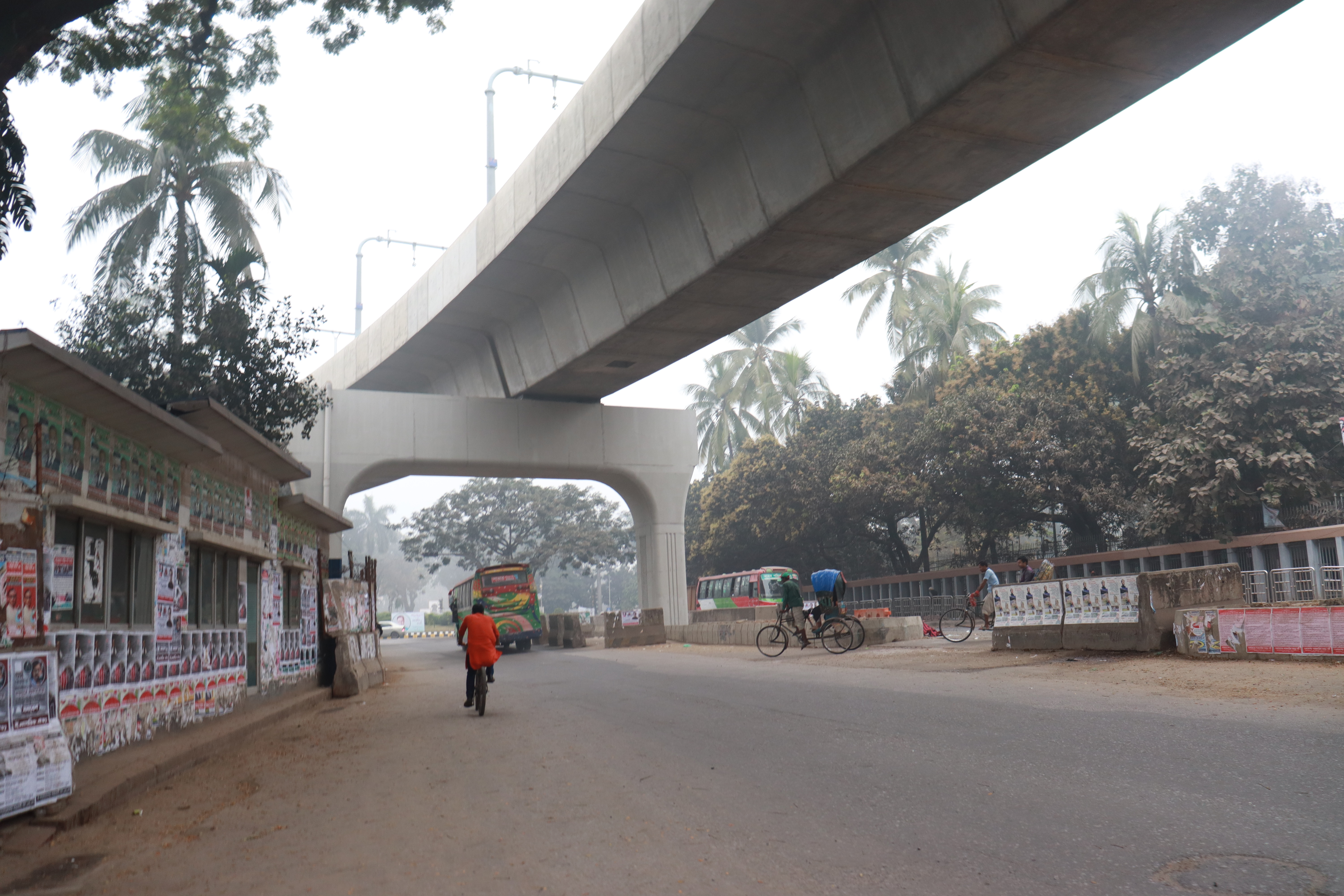
On 16 September, the Executive Committee of the National Economic Council approved a revised cost of Tk 2,04,243.25 crore for Dhaka's MRT Line-1 and MRT Line-5 Northern Route, a 117.74 percent rise over the Tk 93,799.97 crore cleared in 2019. The meeting, the third ECNEC session of fiscal year 2027, chaired by Prime Minister Tarique Rahman, signed off on a combined increase of Tk 1,10,443.28 crore for 51.24 kilometres of track. By this paper's arithmetic that is Tk 3,986.01 crore per kilometre, the highest per-kilometre figure in the regional benchmark set DMTCL published, roughly ten times India's reported underground upper bound in the same set.
At roughly Tk 3,986 crore per kilometre, the revised lines sit far above every benchmark DMTCL published, and the line items that would explain the gap have not been published.
Revision, line by line
The 31.24-kilometre MRT Line-1 connects Hazrat Shahjalal International Airport with Kamalapur and carries an elevated branch from Natun Bazar to Purbachal. Its cost moved from Tk 52,561.43 crore to Tk 1,14,394.89 crore, an increase of Tk 61,833.46 crore or 117.64 percent. The government's own contribution rises 133 percent to Tk 30,552.26 crore; the Japan International Cooperation Agency loan rises 112.53 percent to Tk 83,842.63 crore. That is Tk 3,661.81 crore per kilometre of Line-1.
The 20-kilometre MRT Line-5 Northern Route runs from Hemayetpur to Bhatara, elevated from Hemayetpur to Amin Bazar and underground through densely populated areas from Amin Bazar to Bhatara. Its cost moved from Tk 41,238.54 crore to Tk 89,848.36 crore, an increase of Tk 48,609.82 crore or 117.88 percent. The government share rises 84.22 percent to Tk 22,330.11 crore; the JICA loan rises 131.89 percent to Tk 67,518.24 crore. That is Tk 4,492.42 crore per kilometre. The project, once due for full operation in 2028, is now proposed for completion by December 2032.
The same ECNEC meeting approved a new metro project, the 17.20-kilometre MRT Line-5 Southern Route from Gabtoli to Dasherkandi, at Tk 45,503.76 crore. That is Tk 2,645.57 crore per kilometre, cheaper per kilometre than either revised line, and it is 13.10 kilometres underground. This is inference, stated as such: the revision's cost drivers attach to the two older projects' specific circumstances, detailed-design changes and Covid-era delays, rather than to a city-wide repricing of metro construction. The new line got priced like a new line; the old lines got repriced like distressed ones.
Cost per kilometre, against the region
The Daily Star, citing a Dhaka Mass Transit Company Limited analysis reported by Prothom Alo, puts metro construction under the current JICA conditions for Lines 1 and 5 at Tk 3,618 crore per kilometre. The completed MRT-6 in Dhaka cost Tk 1,574 crore per kilometre. The table below sets the revised lines against regional and global benchmarks.
| Project / city | Tk crore per km | Source |
|---|---|---|
| MRT Line-5 Northern Route, Dhaka (revised) | 4,492.42 | This paper, from ECNEC figures |
| MRT Line-1, Dhaka (revised) | 3,661.81 | This paper, from ECNEC figures |
| Dhaka Lines 1 and 5 under JICA terms | 3,618 | DMTCL via Prothom Alo, cited by Daily Star |
| MRT Line-5 Southern Route, Dhaka (new) | 2,645.57 | This paper, from ECNEC figures |
| MRT-6, Dhaka (completed) | 1,574 | Daily Star |
| Seoul, South Korea | 784 | DMTCL via Prothom Alo, cited by Daily Star |
| Bangkok, Thailand | 740 | DMTCL via Prothom Alo, cited by Daily Star |
| Turkey | 672 | DMTCL via Prothom Alo, cited by Daily Star |
| India, underground (upper bound) | 450 | Daily Star |
| Patna, India (JICA-funded, Indian contractors) | 450 | Daily Star |
| Ivory Coast | 448 | DMTCL via Prothom Alo, cited by Daily Star |
| India, elevated | 150 | Daily Star |
Read the gap, not the rank. Dhaka's revised underground-heavy lines cost roughly ten times India's reported underground upper bound in the same benchmark set, and more than double what Dhaka itself paid for the completed elevated MRT-6. The Patna row is a test, not a verdict: Patna's metro is also JICA-financed, and Indian contractors are building its underground sections at about Tk 450 crore per kilometre. If Japanese financing terms alone explained the price, that gap should not exist. It does, which points the inquiry at procurement conditions rather than loan terms, but the test does not identify the dominant cause. Only the revised DPP line items can do that.
Where the money goes
The revision's stated drivers are: delays in design and tender preparation during the Covid-19 pandemic, the complexities of building the country's first underground metro, and detailed-design changes including larger stations, relocated entrances, exits and ventilation shafts, a three-storey Rajarbagh station, and about 20 kilometres of detour roads for traffic management during construction. The Project Evaluation Committee's reassessment covered mainline construction, land development, buildings, electrical and mechanical systems, utility relocation, and equipment.
Note how much of that list is not track. Land is bought at three times the market price under standing government policy, with compensation for physical infrastructure and resettlement of affected people on top, a policy the planning minister MA Mannan stated on the record when the lines were first approved. The JICA resettlement action plan for Line-1 budgets BDT 19.48 billion for land acquisition and resettlement alone. The newly approved Line-5 Southern Route carries Tk 49.79 billion for land acquisition and rehabilitation, about 134 hectares, and another Tk 9.31 billion for utility relocation, against a Tk 455.03 billion project. These are the mechanisms ECNEC and the Project Evaluation Committee named: land acquisition, rehabilitation, detour roads, relocated station infrastructure, and utility shifting. Whether they are the dominant causes is not yet provable: the revised DPP line items showing where the additional Tk 1,10,443.28 crore sits have not been published, so the shares are the state's account, not a verified allocation.
JICA premium
The Daily Star's analysis names the mechanism: under the loan conditions Bangladesh accepted, the same country's entities plan, finance, study, consult, and execute the project, a structural conflict of interest. India, the analysis notes, takes foreign infrastructure loans without accepting conditions that undermine competitive bidding, so local contractors win the work and costs stay near Tk 450 crore per kilometre for underground sections. JICA's defense is quality, that higher upfront costs reduce long-term maintenance. The Patna figure is hard to square with a pure quality premium: if JICA can maintain its quality standards at about Tk 450 crore per kilometre in Bihar, the gap needs another explanation. The Daily Star's analysis names procurement structure as the mechanism; that is the analysis's claim, and it stays a claim until the line items land.
The Business Standard reported in September 2025 that Dhaka's metro costs five times India's, that the government had raised cost optimization directly with JICA for the first time, and that India's JICA-financed Patna, Pune, and Indore metros all finished 14 to 24 percent below their original budgets while Dhaka's lines rose 118 percent. The revision approved this month answers none of that. It reprices the overrun and moves on.
Fares will carry the ledger
The debt stack is now overwhelmingly foreign: JICA carries Tk 83,842.63 crore of Line-1 and Tk 67,518.24 crore of Line-5 North, with ADB and Korea's Economic Development Cooperation Fund financing the new southern line. The farebox has to service it. Transport analyst Faruque told The Business Standard that a ride from Uttara to Motijheel costs Tk 100 on MRT-6 today and that the same trip on MRT-1 could cost Tk 300 at the revised economics. That is the revision's last-mile incidence: a metro priced for a commuter base that cannot pay metro prices becomes either a subsidy sink or a ghost train.
State cut its own number
One detail belongs in the record because it disciplines the forensics. DMTCL's August proposal put the combined revision at Tk 2,13,985.09 crore. The Project Evaluation Committee's 30 August meeting recommended cuts, and the revised proposals sent to the Planning Commission on 13 September came in Tk 9,741.84 crore lower. The state's own evaluators did not believe the operator's first number. The second-revision syndrome is not a metaphor here; it is the documented sequence. A revision of the revision still landed at 117.74 percent over the 2019 approval.
What would prove this wrong
This analysis stands or falls on the revised DPP line items. If the published line items show the additional Tk 1,10,443.28 crore concentrated in land acquisition, resettlement, utility relocation, detour roads, and the named design changes, the mechanism account holds and the procurement-structure reading weakens. If they show the bulk of the increase inside construction and systems contracts repriced without matching scope change, the procurement reading hardens and the named-mechanisms account fails. Either way, the numbers that decide it are not public yet.
Sources
- Prothom Alo (English), "ECNEC approves Gabtali-Dasherkandi metro rail project, 11 others worth Tk 1.69 trillion," 16 Sep 2026.
- Dhaka Tribune, "ECNEC clears three metro rail projects involving Tk250,000 crore," 16 Sep 2026.
- Ittefaq (English), "3 metro rail projects get ECNEC nod," 16 Sep 2026.
- Dhaka Stream, "ECNEC approves 12 projects, including new metro rail," 16 Sep 2026.
- Outlook Bangla, "ECNEC approves 12 projects involving Tk 1,68,780cr including 3 metro projects," 16 Sep 2026.
- The Daily Star, "Dhaka's Metro Rail: Why are we paying so much?" (opinion).
- The Business Standard, "Dhaka Metro costs 5 times India's: Jica review sought to cut millions," Sep 2025.
- The Business Standard, "Ecnec approves new and costlier metro rail projects," 2019.
- Prothom Alo (English), "Gabtoli-Dasherkandi metro rail project to go before ECNEC Wednesday, cost estimated at Tk455.03 billion," Sep 2026.
- JICA, "Mass Rapid Transit Development Project (Line 1): Final Report (Summary)," resettlement budget table 5.19.1.