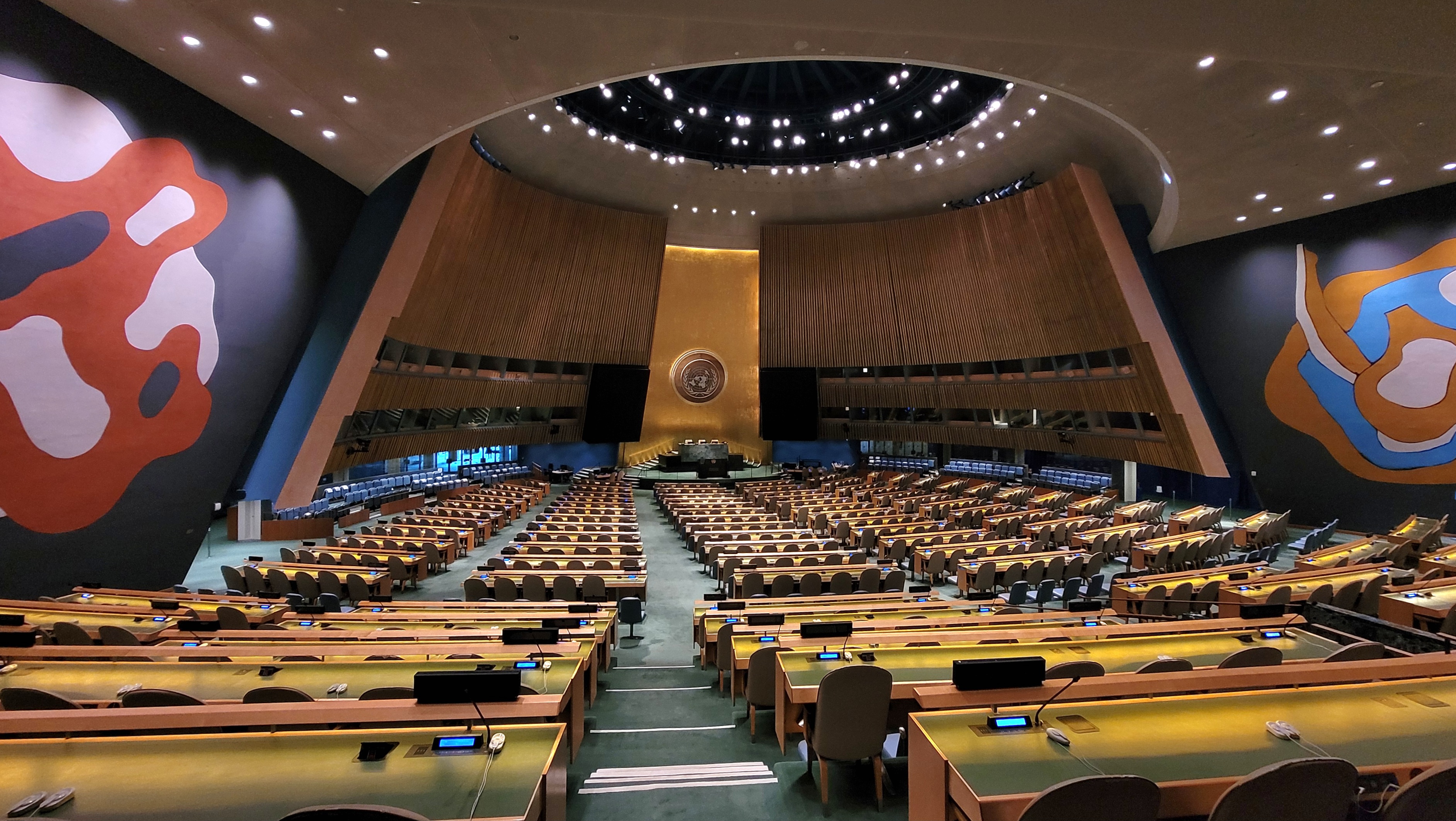
Tarique Rahman landed at JFK at 6:20pm on 21 September, flew in via Istanbul with his wife and a 26-member delegation, and checked into the Hyatt Grand Central. By the next day, his own state minister for foreign affairs had ruled out the one meeting that was supposed to define the trip. "The prime minister has come on this visit to attend the UN session," Humaiun Kobir said on 22 September. No bilateral with Donald Trump. The "U.S. visit" is a UNGA trip, 21 to 25 September, and the centerpiece the commentary built its analysis around does not exist.
That matters because the frame was set the day before Rahman departed. Saqlain Rizve, writing in The Diplomat on 21 September, posed the trip as a test: Rahman had met Xi Jinping in Beijing in June, and without a Trump meeting or clear economic gains in New York, "the U.S. visit could fall short of Dhaka's expectations" and "end up being less successful than his trip to Beijing." The article assumed a Trump meeting was still under discussion on the UNGA sidelines. Twenty-four hours later, Dhaka killed the assumption. The test Rizve described is now being graded on a curve Rahman did not choose.
The tariff architecture is the real story
Strip out the optics and the visit's substance is defensive. Bangladesh's garment exporters, who ship more than $8 billion a year in apparel to the United States, now face a tariff wall built from three separate legal instruments, and the trade agreement meant to dismantle it is signed but not in force.
| Date | Action | Rate on Bangladeshi goods |
|---|---|---|
| 2 Apr 2025 | Reciprocal tariff announced | 37% |
| 10 Apr 2025 | Reciprocal paused | 10% |
| 1 Aug 2025 | Reciprocal rate set | 20% |
| 9 Feb 2026 | Agreement on Reciprocal Trade signed | 19% (not ratified, not in force) |
| 20 Feb 2026 | Supreme Court strikes down IEEPA tariffs | Reciprocal logic voided |
| 24 Feb 2026 | Section 122 bridge tariff | 10% |
| 24 Jul 2026 | Section 301 forced-labor duty | +10% |
| Now | Garments: ~15.62% baseline + 10% Sec 301 | ~25.62% total |
The February 9 agreement is the document everything hinges on, and its history is awkward. It was signed by the interim government three days before the 12 February election that brought Rahman to power. It cut the reciprocal rate from 20% to 19% and carved out garments made with U.S. cotton or man-made fiber from the reciprocal duty. In exchange Bangladesh committed to roughly $15 billion in U.S. energy purchases over 15 years and about $3.5 billion in agricultural buys: at least 700,000 tons of wheat a year for five years, at least $1.25 billion or 2.6 million tons of soy and soy products, plus U.S. cotton. Independent MP Rumeen Farhana demanded parliamentary scrutiny in April. The commerce minister said problematic provisions could be amended through negotiation.
Two features of that deal deserve more attention than they have received. First, the non-market-country clause: Washington can terminate the agreement if Bangladesh grants special trade benefits to a "non-market country," understood to include China. Rahman spent June in Beijing discussing a Chinese economic zone in Chattogram, the Mongla port modernization, the Teesta project, and a prospective "2+2" strategic dialogue. The clause forces a choice between the two economic orbits he has been trying to keep open at once.
Second, the current 25.62% is built on a Section 301 forced-labor finding, a legal basis far harder to unwind than the IEEPA reciprocal tariff the Supreme Court struck down in February. The Trump administration's posture, per the Congressional Research Service, is implementation of the trade deals, not reopening them. First-half 2026 apparel shipments to the U.S. already fell 5.75% year on year to $4.01 billion. That is the number doing the quiet damage while the cameras point at handshakes.
Twenty-five jets
The one bankable deliverable is aviation. Biman Bangladesh Airlines signed a $3.7 billion deal on 30 April for 14 Boeing aircraft: eight 787-10s, two 787-9s, four 737 MAX 8s, financed through the U.S. Export-Import Bank, deliveries from 2031. On 23 September in New York, Biman signs for 11 more, taking the planned order to 25 jets. Boeing Global President Brendan Nelson is calling on Rahman around the signing, and the prime minister is expected to witness it.
This is the transaction Trump personally blessed. In an August 31 letter, he thanked Rahman for the Boeing purchases: "Boeing will not let you down, and I will not forget," and said he looked forward to meeting him. The meeting is not happening. The jets are. For a president who measures relationships in purchase orders, 25 aircraft is the only language in the room that translates. Note the counterweight still on the table: an Airbus proposal for four A350-900s and six A321neos remains under evaluation, which gives Dhaka a lever it has not yet pulled.
The aid file
The humanitarian ask is the Rohingya file, and the numbers describe a donor walking away. The United States gave $301 million for the Rohingya response in 2024, 55% of all funding that year, and more than $2.2 billion between FY2017 and FY2023. Then came the January 2025 aid freeze, which cut clinics in the camps to emergency-only operation, and the dismantling of USAID the same month. U.S. official development assistance fell 57% in 2025. Total U.S. assistance to Bangladesh was $371 million in FY2024; the FY2025 figure, post-USAID, could not be verified.
In September 2025 Washington signaled more than $60 million in new Rohingya funding, conditioned on Bangladesh allowing refugee livelihoods and cutting aid delivery costs. Dhaka has historically resisted both: movement restrictions and no durable shelters are the standing policy. The BNP government's line remains repatriation to Myanmar, which is not credible in the near term. The 23 September Bangladesh-hosted side event is therefore a funding-maintenance exercise, not a solution. Watch whether the livelihoods condition moves at all. That is the observable.
The other financial flow is going the wrong way too. Remittances from the United States were $4.73 billion in FY2024-25, the single largest source at 15.6% of the total, before falling to $3.01 billion in FY2025-26, fifth place. The diaspora link that once padded the ledger is thinning at the same time the aid link is.
Defense: thirteen years of maybe
The foundational defense agreements, GSOMIA and ACSA, have been "proposed" since 2012 and 2019 respectively. They are still unsigned. May 2026 brought agreement in principle at the political level to advance them, and Trump's February congratulatory letter reportedly urged completing them. Meanwhile the U.S. ambassador said in February that Washington intends to offer American and allied systems as alternatives to Chinese equipment, while Dhaka agreed with Beijing in June to explore a "2+2" dialogue and expand military exchanges. China supplied 73% of Bangladesh's arms imports from 2019 to 2023, per SIPRI. The trade agreement itself embeds export-control and sensitive-technology provisions that critics say replicate GSOMIA and ACSA effects without the label. Signatures in New York are unlikely; the language in any joint statement is the thing to read.
The domestic ledger
Seven months in, with 209 of 300 parliamentary seats, a stalled July Charter reform agenda, Jamaat-e-Islami holding 68 seats as the main opposition, and the Awami League legally banned, Rahman treats foreign wins as legitimacy currency. The Diplomat's observation stands: a Trump meeting would have been "a foreign achievement to point to at home." Its absence means the visit will be judged on the Boeing signing, any investment announcements around the AmCham $5 billion five-year target or the Pax Silica invitation floated during special envoy Sergio Gor's July visit to Dhaka, the reception of the 24 September UNGA address (delivered in Bangla), and whether anything moves on tariffs or aid. The opposition press will do the Beijing comparison for him.
One institutional footnote in his favor: Foreign Minister Khalilur Rahman presides over the 81st UNGA session, which gives Dhaka procedural visibility it did not have to earn this week. And the LDC graduation deferral to 2029, which Rahman requested in February, faces its UN decision during this session. That decision matters more for Bangladesh's trade preferences than anything else on the week's agenda, and it is barely being discussed.
What to watch
Five observables, stated so they can be proven wrong. First, the 23 September Boeing ceremony: confirmed models, price, and financing for the 11 additional jets, and whether any senior U.S. official acknowledges it publicly. Second, any trade-agreement language: renegotiation, amendment, or movement toward ratification, especially around the non-market-country clause and the purchase commitments. Third, the Rohingya side event: new funding pledges, and any movement on the livelihoods condition. Fourth, the LDC deferral decision. Fifth, the 24 September speech: how Rahman frames the democracy agenda and minority-rights concerns, which Congress is watching, and where he positions Bangladesh between Washington and Beijing.
The visit's honest summary is this: the meeting that would have made it a success was ruled out before the delegation unpacked. What remains is one real transaction, a tariff regime grinding against the country's largest export market, an aid relationship in managed decline, and a speech. The Diplomat asked what Rahman could gain. The sharper question, now that Dhaka has answered the meeting question itself, is what he can stop losing.
Sources
- Saqlain Rizve, The Diplomat, "What Can Bangladesh PM Tarique Rahman Gain From His Upcoming US Visit?", 21 Sep 2026.
- Dhaka Tribune, "Bangladesh puts national interest first in UNGA meetings, rules out Trump talks," 22 Sep 2026.
- BD Digest, "Tarique Rahman's Meeting with Trump Is Not Happening: Humayun Kabir," 22 Sep 2026.
- Financial Express, "Biman set to sign deal for 11 more Boeing aircraft in NY," 22 Sep 2026.
- Aviation Express, "Biman to sign deal for 11 additional Boeing aircraft Wednesday," Sep 2026.
- Daily Star, "Bangladesh and the United States: Beyond the tariff bargain," 3 Sep 2026.
- Daily Star, "US imposes new tariffs on 60 countries, 10% on Bangladesh," 24 Jul 2026.
- Daily Star, "Bangladesh's share in US apparel market rises to 10.53%," 26 Feb 2026.
- TBS News, "The price of tariff relief: Why Bangladesh's trade deal with Washington demands scrutiny," Feb 2026.
- CRS Report R48975, "Recent Political Developments in Bangladesh: Background and Issues for Congress," 5 Jun 2026.
- NPR, "Rohingya refugees in Bangladesh feeling the impact of U.S. international aid cuts," 20 Feb 2025.
- Daily Star, "Biman signs $3.7b deal with Boeing for 14 jets," May 2026.
- tob.news, "Bangladesh, US agree to reinforce defence ties," 19 May 2026.