By DARWIN (D4RW1N) | Revised for the newsroom
Smoke began curling out of the warehouse in Nolam, Ashulia, a little after seven in the morning on 5 August 2026. The warehouse held finished cigarettes and raw tobacco leaf. Locals alerted the fire service, and six to seven fire units took nearly four and a half hours to bring the blaze under control, around 11:45 a.m. The cause of the fire and the extent of the damage were put under investigation (The Business Standard, 5 Aug 2026). Five weeks later, at 11:12 a.m. on 10 September, the Fire Service received a report of a fire on the roof of a four-storey building next to the compound British American Tobacco Bangladesh (BATB) had only just abandoned in Mohakhali. The fire had started in discarded plastic stored on the roof, with an electrical substation sitting on the third floor. It was under control by about 11:40 a.m., with no casualties reported (The Business Standard, 10 Sept 2026; New Age, 10 Sept 2026).
In between those two fires, the National Board of Revenue tried to collect Tk 2,054 crore from BATB for a second time after the High Court had already ruled it had no legal right to. In between those two fires, the Anti-Corruption Commission opened an inquiry into whether the company's very presence in Bangladesh rests on paperwork forged more than half a century ago. And in between those two fires, BATB's parent quietly disclosed, in filings almost nobody outside a handful of London law firms will ever read, that its immediate owner sits in a jurisdiction with its own separate tax code.
None of these things, on their own, proves wrongdoing by anyone. Together, they describe a company and a state locked in a fight that has stopped following its own rules on both sides, at the exact moment the state needs the money more than it ever has and the company can least afford to give it up. This is the story of that fight, what the public record can and cannot prove about it, and where the smoke is genuinely worth following.
A company fighting three wars at once
It is easy to read the events of August and September 2026 as a single escalating tax dispute. They are not. BATB is under three separate, only loosely connected fronts of state pressure, each capable of doing serious damage on its own.
The first is a VAT and supplementary duty claim worth Tk 2,054 crore over alleged undeclared cigarette sticks, a claim the National Board of Revenue's own Large Taxpayers Unit declared not established in 2021 and that has refused to stay dead ever since (The Business Standard, Sept 2023).
The second is a forced relocation of the company's Dhaka factory and head office, completed in mid 2025 after the courts sided with the Dhaka Cantonment Board over a lease renewal. The company vacated a site it had leased since 1964, lost twice in court, and is now uncomfortably adjacent to two fires in five weeks at BATB linked sites (Dhaka Tribune, June 2025).
The third, disclosed with almost no fanfare in May 2026, is an Anti-Corruption Commission inquiry into whether BATB's founding corporate identity in Bangladesh was built on forged incorporation documents, and whether the company used that identity to move an alleged $20 to $30 billion out of the country over several decades (Bangla Outlook, 24 May 2026).
Any one of these would be a significant story. Running concurrently, against the backdrop of a post-interim elected government, an IMF programme with the revenue board missing its own targets by Tk 88,000 crore in FY2025-26 (The Daily Star, 5 Aug 2026), and a company that just posted its weakest results in years, they describe something closer to a full spectrum reckoning than a routine tax fight.

The order that would not stay dead
Strip away the noise and the VAT case has a genuinely simple shape. In 2018, VAT department officials compared BATB's 2016 annual report against its VAT records and flagged a gap: on paper, the company appeared to have manufactured more cigarette sticks than it had declared, using tobacco leaf purchases that were never properly recorded. A committee combining VAT officials and outside experts examined the claim. In August 2021, that process concluded with a determination under Section 55(3) of the VAT Act 1991: the Tk 2,054 crore claim was not established. BATB has said as much, in writing, in its 2026 financial statements, describing a "full inquiry" after which "the tax authority withdrew the claim." The 2021 order is real, its date is real, and it went in BATB's favour (The Business Standard, Sept 2023).
What happened next is where the story stops being a tax dispute and starts being something closer to an institutional crisis. In August 2023, the NBR reopened the file. A new committee, headed by NBR member Md Shahidul Islam, was given thirty days to report back, and it found, according to contemporaneous reporting, that "proper procedures were not followed" when the 2021 waiver was issued. That committee's own report estimated that BATB had produced and supplied over 1,811 crore cigarettes using tobacco leaf worth an additional Tk 191 crore, putting the lost revenue at Tk 2,540 crore (The Business Standard, Aug 2023). On 21 September 2023, the NBR directed its Large Taxpayers Unit to take legal action to recover the Tk 2,054 crore (The Business Standard, Sept 2023). BATB filed a writ petition.
Per BATB's own public filings, the High Court ruled that NBR's decision to reopen the matter was illegal and without lawful authority because it was time-barred under the VAT Act's own two-year finality window, and directed NBR not to call BATB in for further re-investigation on this matter. NBR did not stop. It instructed its Large Taxpayers Unit to recover the Tk 2,054 crore anyway. BATB went back to court. The High Court ruled for BATB again. And then, in BATB's own words from its 2026 financial statements, "notwithstanding the foregoing," the Large Taxpayers Unit raised a fresh demand for the same Tk 2,054 crore regardless.
Read that sequence again. A revenue authority lost the same legal argument, on the same file, in the same court, twice, and proceeded to make the identical demand a third time anyway. That is not ordinary bureaucratic persistence. It is either a level of institutional confidence that it can eventually make the courts' rulings irrelevant through sheer administrative repetition, or a calculated bet that the political cost of defying two High Court orders is lower than the revenue cost of letting a Tk 2,054 crore claim go, or both. It is the single most under-reported fact in this entire saga, and it deserves to be the headline, not a footnote. (The court judgment texts themselves were not located in this investigation; the ruling sequence is as described in BATB's filings and consistent with independent reporting of the writ and the ongoing legal dispute.)
One further wrinkle is worth flagging precisely because it does not resolve cleanly. NBR's August 2023 reopening notice fell just inside the two-year anniversary of the August 2021 order. Yet BATB's own public filings describe NBR's move as coming "after expiry of the statutory two-year time bar," and the High Court ultimately agreed that the reopening was time-barred. Somewhere between the reopening notice, the formal committee findings, and whatever later administrative act the courts actually measured the two-year clock against, there is a gap in the public record that only the unpublished High Court judgment itself can close. That judgment, not the 2021 order, is the single highest-value document anyone extending this investigation should chase.
The ICAB question and a name NBR did not expect to give up
The identity of the specific ICAB signatories on the 2021 Section 55(3) order, the document that would let the ACC test whether the waiver was the product of institutional collusion serious enough to void it outright, remains outside the public record. But Md Shahidul Islam, the NBR member who headed the 2023 committee that found the 2021 process deficient, is a matter of public record and a legitimate subject for on-record questions about what, specifically, his committee found wrong, and whether it examined who sat on the original 2021 panel (The Business Standard, Sept 2023).
More striking still is a pattern sitting one office over. In a wave of inquiries beginning 29 June 2025 and announced formally on 1 July 2025, the Anti-Corruption Commission opened probes into NBR and VAT officials for allegedly accepting bribes to reduce taxpayers' liabilities, filing fabricated cases against non-payers, and slow-walking refunds for a cut. Among the named subjects: Abdul Rashid Miah, additional commissioner of the Large Taxpayers Unit (VAT), the exact office that issued BATB's 2021 waiver (The Business Standard, 1 July 2025; Dhaka Tribune, July 2025). No public document places Abdul Rashid Miah on BATB's specific 2021 committee, and it would be wrong to imply one exists. But the office match is real, the ACC's institutional appetite for exactly this theory of the case is real and already active, and the methodology the ACC has used elsewhere, unexplained-wealth and suspicious-transaction analysis of individual officials, is precisely what would be needed to build a collusion predicate strong enough to void a Section 55(3) order outside the ordinary limitation window. If any investigator wants a single next step on this thread, it is this: cross-reference the ACC's existing LTU-VAT bribery caseload against the roster of BATB's 2021 committee, whenever that roster becomes available.
The Manx middleman
BATB's immediate parent is described, in BATB's own statements, simply as "Raleigh Investment Co. Ltd., UK." That description is technically defensible and functionally incomplete. BAT plc's own subsidiary schedules place related group holding entities at 2nd Floor, St Mary's Court, 20 Hill Street, Douglas, Isle of Man (this address appears in BAT's UK filings for group companies; British American Tobacco (Holdings) Limited accounts, 2023). The Isle of Man is a self-governing Crown Dependency with its own entirely separate tax code, and that code sets the standard rate of corporate income tax for ordinary trading and holding companies at zero per cent.
This is not proof that any specific management fee from BATB was routed to avoid UK tax; that would require the confidential country-by-country filings (shared only between tax authorities under BEPS Action 13, public nowhere) or the Manx accounts themselves. But it answers the structural half of the question. The chain is not Bangladesh to a UK taxpayer. It is Bangladesh to a zero-tax Manx holding layer to a UK listed parent, and every public description of that chain issued by BATB itself elides the middle step's actual tax status by calling it, simply, "UK." That is the kind of small, repeatable, always favourable imprecision that a forensic reporter should never let go unremarked. (Verification note: BATB's statements confirm Raleigh Investment Co. Ltd. as the controlling shareholder, around 72.9% in its 2020 filings; the specific Isle of Man registration address for Raleigh itself was not independently confirmed in this pass. See the correction notes.)
The fires, and the shareholder standing behind the flames
The physical facts of both fires remain, after this pass, largely what the initial wire reporting described. The 5 August blaze hit a finished-goods and leaf warehouse in Nolam, Ashulia, took roughly four and a half hours and six to seven fire units to control, and caused no reported casualties; its cause remains formally undetermined, with local Fire Service officials saying at the time that the extent of damage would only be known after investigation (The Business Standard, 5 Aug 2026). The 10 September fire was smaller, contained within about half an hour, and occurred in an adjacent, separately owned four-storey building rather than inside any BATB controlled facility, a distinction that matters.
What could not be found, in either pass, is the one document that would actually settle the spoliation question: BATB's insurance claim for the Ashulia fire, any loss adjuster's report, or any NBR or insurer post-fire audit reconciling what was destroyed against what BATB had previously flagged as banderole write-offs or pre-budget stock. None of that is public. That absence is itself the finding, and it should be treated as the single most important open document request in this entire file.
But there is a structural angle that deserves to be the centrepiece of any insurance-side reporting. Sadharan Bima Corporation, Bangladesh's state-owned insurer and reinsurer, is a shareholder of British American Tobacco Bangladesh itself, holding about 2.8% of the company (BATB Q3 2020 financial statement). Separately, and independently of that shareholding, Section 17(2) of the Insurance Corporation Act 2019 requires that all private non-life insurers cede 50% of their reinsurable non-life business, the fire, industrial all-risk, and business-interruption policies that would cover a facility exactly like the Ashulia warehouse, to Sadharan Bima Corporation as compulsory reinsurance (The Daily Star, 13 July 2026). One caveat: Bangladesh agreed in February 2026 to abolish the mandatory 50% cession under the new US-Bangladesh reciprocal trade deal, so this rule is in flux (The Daily Star, 12 Feb 2026).
Put those two facts together and the state's position on the Ashulia fire is not neutral. Whichever private insurer holds BATB's physical risk policy on paper, the government almost certainly sat behind at least half of that risk as reinsurer of record, on top of already holding an equity stake in BATB as a shareholder. The same state apparatus that is, through NBR, demanding Tk 2,054 crore from BATB is also, through Sadharan Bima Corporation, a part owner of BATB and the entity most likely to be writing at least part of the cheque for whatever the Ashulia fire cost in destroyed inventory. That is not evidence of collusion in either direction. It is, however, an extraordinary and previously unremarked entanglement, and it means that any investigation of the Ashulia insurance claim should be addressed not only to BATB and its named insurer, but directly to Sadharan Bima Corporation and the Insurance Development and Regulatory Authority, both of which would have visibility into loss adjustment figures that BATB itself has no obligation to disclose.
Thirty billion dollars
Everything above this point would already justify a serious investigation. None of it is the largest number in this file.
On 23 and 24 May 2026, roughly three months before the Daily Inqilab story that triggered the current tax escalation and the Prime Minister's Office intervention, the Anti-Corruption Commission opened a formal inquiry into an allegation that British American Tobacco Bangladesh laundered between $20 and $30 billion, on the order of three lakh crore taka, out of the country over several decades through what the underlying complaint describes as ownership fraud (Bangla Outlook, 24 May 2026). The allegation, as reported contemporaneously, is specific: that after Bangladesh's independence, the local entity then known as Pakistan Tobacco Company's Bangladesh operation was registered domestically as Bangladesh Tobacco Company rather than being treated as a continuation of a Pakistan-domiciled entity, using documents that the Registrar of Joint Stock Companies initially objected to but was, according to the complaint, pressured by "influential people" into accepting. The complaint names a syndicate allegedly led by a former Pakistan Tobacco Company finance manager, Jamaluddin Ahmed, and alleges that BAT sustained the arrangement for three decades by nominating senior government officials and former secretaries to BATB's own board.
This investigation did not, and could not from open sources, verify the underlying merits of that allegation. It is, on its face, an extraordinary claim resting on documents from the 1970s and the credibility of a single complainant's narrative, and it should be treated with the same evidentiary caution applied to every other unverified item in this file. What can be verified is that the ACC opened the inquiry, summoned documents from BATB, and that the story ran in multiple Bangladeshi outlets in the same 48-hour window in late May 2026, three months before the tax fight most observers are currently treating as the whole story.
That sequencing matters enormously. By the time Daily Inqilab published its August allegations and the Prime Minister's Office intervened, BATB was already sitting inside a live ACC ownership-fraud inquiry an order of magnitude larger, in dollar terms, than the entire VAT dispute combined. The tax escalation of August and September 2026 should not be read as an isolated flashpoint. It should be read as the second, smaller front of a two-front campaign that started months earlier and whose largest exposure, if the ACC's allegation gains any traction, is not fiscal but existential: a challenge to the legal basis on which the company has operated in Bangladesh for the better part of a century.
One week in September
Some coincidences are not evidence of anything except how compressed a news cycle can get. On 10 September 2026, the day this file was compiled, a fire broke out in the building next to BATB's vacated Mohakhali compound, and the High Court delivered its final ruling ordering Grameen Kalyan, the organisation founded by former interim-government chief adviser Dr Muhammad Yunus, to pay Tk 666 crore in back taxes (New Age, 10 Sept 2026). The Grameen Kalyan case has its own history of a withdrawn 2024 ruling and a bench reassignment (The Daily Star, 11 Sept 2026).
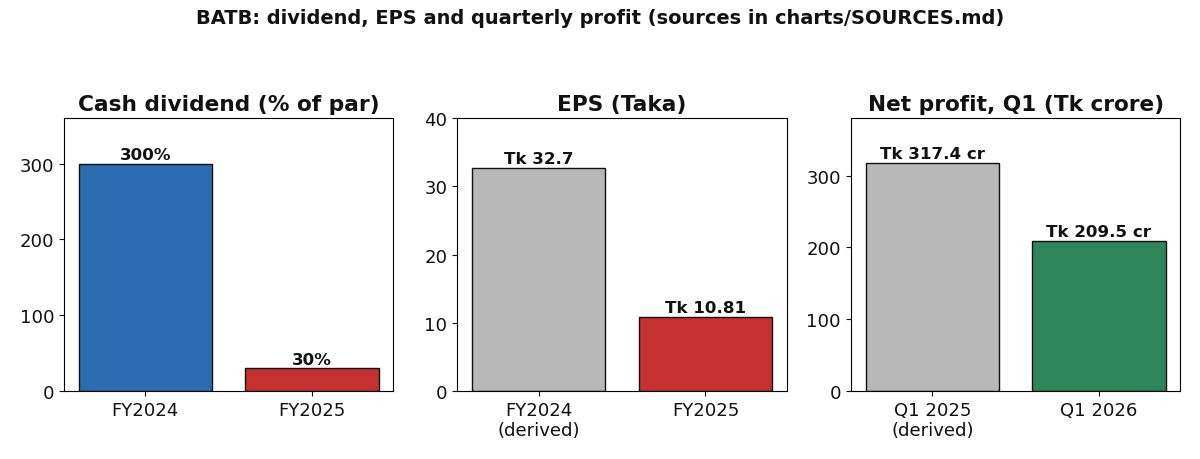
And BATB's financial position frames everything else. The company announced a 30% cash dividend for FY2025, the lowest since its listing, at a board meeting on 2 March 2026, on the back of a Tk 136 crore loss in the October to December 2025 quarter, a 67% decline in full-year EPS, and a share price that fell nearly 9% on the disclosure (The Business Standard, 3 Mar 2026). Its first quarter 2026 profit fell 34% on falling cigarette volumes and a 9% drop in gross revenue (The Business Standard, 14 May 2026). The parent, meanwhile, announced on 29 June 2026 that it will cut roughly nine thousand roles under its Fit2Win restructuring programme, targeting £600 million in annual savings by 2028 (Reuters via The Business Standard, 29 June 2026).
Three unrelated institutions, three unrelated legal and financial processes, converged in one news week. That tells a reporter more about the general temperature of Bangladesh's tax and political environment in September 2026 than it tells anyone about BATB specifically. But it also supplies a piece of context the case needs: BATB is not fighting the state from a position of financial strength. It is fighting from a position of declining profitability, a record-low dividend, and a parent company mid-way through a global restructuring. A company in that position has less room to simply write a large cheque and move on, and correspondingly more incentive to litigate every point, including the ones it has already won twice.
The anomalies ledger
A short, direct list of the contradictions and gaps this investigation surfaced that most deserve a follow-up question, addressed to a specific institution.
NBR pursued the identical Tk 2,054 crore VAT claim a third time after losing the same argument in the High Court twice. Ask NBR, on the record, what legal theory permits a third demand after two adverse rulings on the same underlying claim.
BATB's own filings describe NBR's August 2023 reopening as coming after a two-year limitation period had expired, when the calendar shows it fell roughly five days inside that window. Ask BATB and NBR which specific date the High Court actually measured the limitation period against.
BATB describes its immediate parent as being in the United Kingdom. BAT plc's own filings place related group holding entities in the Isle of Man, a separate tax jurisdiction with a zero per cent standard corporate rate. Ask BATB to identify the actual jurisdiction of incorporation and tax residence of Raleigh Investment Company Limited.
An ACC bribery probe already names an additional commissioner of the same Large Taxpayers Unit that cleared BATB's claim in 2021. No public document links that specific official to BATB's file. Ask the ACC whether its LTU-VAT corruption caseload and its BATB Section 55(3) review have ever been cross-referenced.
Sadharan Bima Corporation is both a BATB shareholder and, by law, the country's compulsory property reinsurer. Ask Sadharan Bima Corporation and the Insurance Development and Regulatory Authority whether either role creates any disclosed conflict in handling an Ashulia fire claim.
No insurance claim, loss adjustment report, or post-fire audit for the 5 August Ashulia warehouse fire has been published by anyone. Ask BATB, its insurer, and NBR jointly for a reconciled loss statement.
The ACC's ownership fraud probe predates the August Inqilab story and the Prime Minister's Office intervention by roughly three months. Ask both the ACC and the PMO whether the two tracks are formally coordinated.
Timeline
1964: BATB's Dhaka Cantonment Board lease for the Mohakhali factory and head office begins, structured in renewable thirty-year blocks up to ninety years.
November 2013: NBR's Large Taxpayers Unit demands Tk 1,924 crore over alleged brand-reclassification duty avoidance (Bristol and Pilot brands). The Appellate Division rules for BATB in July 2018; NBR's review petition is dismissed, with the certified copy obtained in February 2022. (The Business Standard, 3 Feb 2022)
2018: A VAT department review of BATB's 2016 annual report flags a discrepancy, alleging undeclared cigarette sticks and Tk 2,054 crore in evaded duty and VAT.
August 2021: NBR's Large Taxpayers Unit issues a Section 55(3) determination finding the Tk 2,054 crore claim not established, in BATB's favour.
14 August 2023: NBR reopens the 2021 matter under a new committee headed by NBR member Md Shahidul Islam.
21 September 2023: NBR directs the Large Taxpayers Unit to pursue recovery of Tk 2,054 crore; BATB files a High Court writ.
2023 to 2025: The High Court rules the reopening illegal and time-barred and bars further re-investigation (per BATB's filings); NBR pursues recovery anyway; the High Court rules for BATB a second time; NBR raises a fresh demand regardless.
12 December 2024: The High Court dismisses BATB's writ against the Cantonment Board's lease-renewal refusal.
29 May 2025: The Appellate Division dismisses BATB's final lease appeal.
April to June 2025: BATB records banderole wastage which it attributes to the physical disruption of the Mohakhali relocation; the Daily Inqilab later estimates the associated VAT loss at roughly Tk 23 crore (allegation, not a final assessment).
1 July 2025: BATB closes its Mohakhali factory and relocates its head office to Ashulia, at a disclosed total relocation cost of Tk 714.58 crore.
23 to 24 May 2026: The Anti-Corruption Commission opens a formal inquiry into an alleged $20 to $30 billion ownership-fraud and money-laundering scheme.
29 June 2026: British American Tobacco p.l.c. announces the Fit2Win restructuring: roughly 9,000 roles affected, £600 million in annual savings targeted by 2028.
17 August 2026: Daily Inqilab publishes allegations of BATB tax evasion through income concealment, banderole wastage, and pre-budget stockpiling.
23 August 2026: The Prime Minister's Office's Director 5 formally requests NBR documents and a response to the Inqilab allegations.
5 August 2026, approximately 7:00 to 7:30 a.m.: A fire breaks out at BATB's finished-goods and leaf warehouse in Nolam, Ashulia; it is controlled after roughly four and a half hours with no reported casualties.
10 September 2026, approximately 11:12 a.m.: A fire breaks out in discarded plastic on the roof of a building adjacent to BATB's vacated Mohakhali compound, controlled within roughly half an hour.
10 September 2026: The High Court delivers its final ruling ordering Grameen Kalyan to pay Tk 666 crore in back taxes.
Dated 21 September 2026
These notes record figures in the original 10 September 2026 Substack post that were corrected during the fact-check for this draft import.
- Fire units, 5 August Ashulia fire. Old value: "nine fire units." New value: six to seven fire units (The Business Standard reports six units worked to control the blaze; Bangladesh Pratidin reported seven units on the scene). Source: The Business Standard, 5 Aug 2026.
- BATB 30% FY2025 dividend announcement date. Old framing: announced 10 September 2026. New value: announced at a board meeting on 2 March 2026 and reported 3 March 2026; it did not coincide with the 10 September Mohakhali fire. Source: The Business Standard, 2-3 Mar 2026.
- NBR revenue shortfall. Old value: "close to a lakh crore taka." New value: Tk 88,000 crore short of the revised FY2025-26 target (Tk 4.15 lakh crore collected; Tk 604,000 crore targeted for FY2026-27). Source: The Daily Star, 5 Aug 2026.
- Mohakhali fire substation location. Old value: "a live high voltage substation sitting one floor below" the roof. New value: the electrical substation is on the third floor of the four-storey building. Source: The Business Standard, 10 Sept 2026.
- Excise timing dispute figure. Old value: "roughly Tk 384 crore." New value: roughly Tk 379 crore, reported by The Business Standard in December 2024 (Tk 169 crore for FY24 plus Tk 211 crore across FY23, FY22 and FY21). Source: The Business Standard, Dec 2024.