Newsroom draft import. Original: DARWIN, Substack, published 2026-07-15 (post ID 207146558). Original subtitle: "On a river between Bangladesh and a rebel state, fertilizer goes out and methamphetamine comes back. This is the story of how a blockaded army turned a nation's addiction into money." This draft is a forensically revised import: every checkable claim carries a source, three figures from the original are corrected, and claims that could not be verified are removed or explicitly labeled. See the correction note at the end.
It was close to nine o'clock on the night of 29 June 2026 when a Border Guard patrol flagged down a consignment on the highway that runs from Cox's Bazar down to Teknaf, the long thin finger of Bangladesh that points into the Bay of Bengal. What the guards found in the vehicle was not what a smuggling story is supposed to be about. It was not heroin. It was not a suitcase of pills. It was one hundred bags of government fertilizer, ordinary urea, the kind a farmer spreads on a rice paddy, the kind the state buys in bulk and sells cheap so that the country can feed itself. (Arakan News)
Two men were arrested with it. The local report named them as Mohammed Jahed and Syed Karim. Investigators said the cargo was headed for the far bank of the Naf River, into the territory held by the Arakan Army, the insurgency that now governs almost the whole of Myanmar's Rakhine State. The men had bought the subsidized fertilizer from a crooked dealer at around two thousand taka a bag. On the other side of the water, they expected the rebels to pay them up to six thousand. Three times the price, for the crime of carrying a sack of nitrogen across a river. (Arakan News)
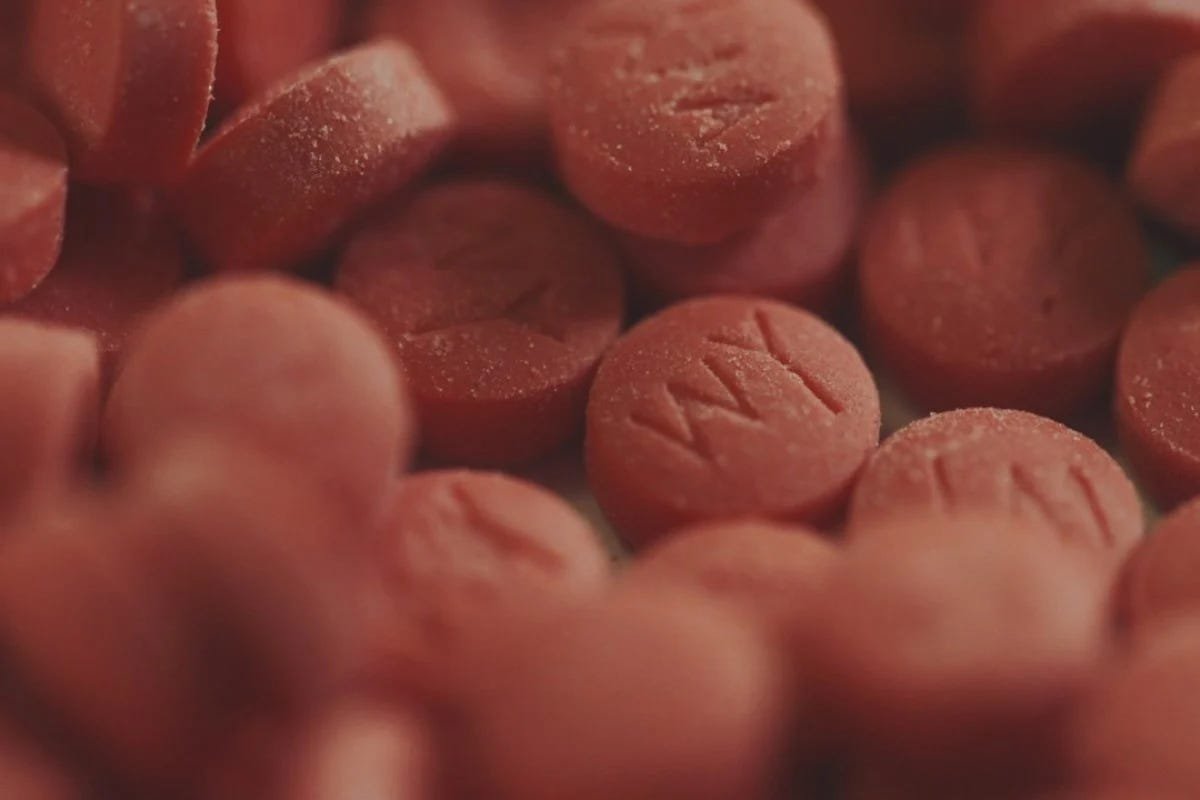
And then, almost as an afterthought, the report mentioned the thing that turns a petty smuggling bust into something far stranger. The same syndicate, it said, tends to combine its fertilizer runs with narcotics, and in particular with yaba, the cheap methamphetamine tablet that has hollowed out a generation of young Bangladeshis. Fertilizer out. Meth back. On the same boats. (Arakan News)
That single interception, on one ordinary night, on one dark stretch of coast, contains an entire war economy in miniature. I have spent a long time reading dispatches from frontiers, and I have learned to distrust the tidy ones. This one is not tidy. But the more you follow it, the harder it becomes to unsee: a stateless army under total siege has quietly conscripted a neighboring country's fertilizer, its cement, its cooking oil, and above all its drug habit, into the supply line of a foreign war. Nobody planned it that way. Almost nobody in the chain has any reason to stop.
What the blockade built
To understand why drugs became money, you first have to understand how, in one small corner of the world, money more or less ceased to exist.
In late October of 2023, the Arakan Army and its allies launched an offensive they called Operation 1027, and it moved with a speed that unsettled even the analysts who had followed Myanmar's civil war for years. The offensive began on 27 October 2023, when the Three Brotherhood Alliance, the Arakan Army, the Myanmar National Democratic Alliance Army and the Ta'ang National Liberation Army, struck together. (Brookings Institution; Jamestown Foundation) Township after township fell. On 8 December 2024, the rebels took Maungdaw and, with it, the entire two hundred and seventy-one kilometers of border that Rakhine shares with Bangladesh. (The Business Standard) By the middle of 2026 the Arakan Army controlled the overwhelming majority of the state. Exactly how much depends on who is counting and what they are counting. By township, The Irrawaddy put the figure at fourteen of seventeen as of May 2025; other outlets have said fifteen. By land and by population, the rebels and their sympathizers claimed more than ninety percent, a claim that cannot be independently measured. The three places still holding out were fortified garrisons, not living countryside.
The junta in the capital could not take the ground back. So it did the other thing an army does when it cannot win. It tried to strangle what it had lost. Myanmar's generals reached for a doctrine so old it has a nickname, the four cuts: sever the enemy's food, its funds, its intelligence, and its recruits. The doctrine was created in Karen State in the 1960s and has been deployed repeatedly, including in Rakhine since 2017. (Jamestown Foundation; Al Jazeera) They sealed the roads. They blockaded the sea. They choked off trade and they choked off aid.
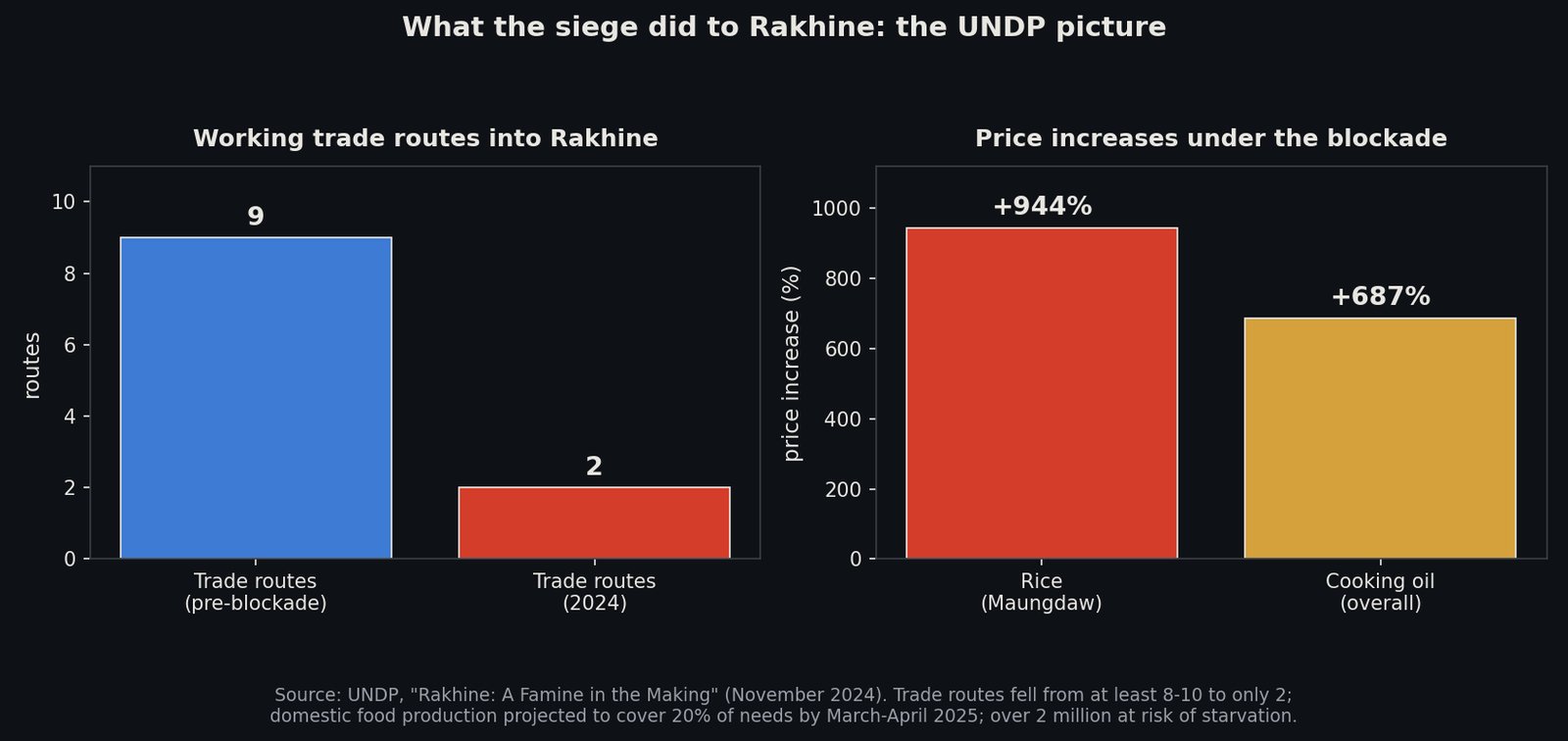
The result is documented not by partisans but by the United Nations. In November of 2024 the UN Development Programme warned that Rakhine's own farms would soon cover barely a fifth of what its people needed to eat, and that more than two million human beings were sliding toward starvation. The number of working trade routes into the state had collapsed from eight or ten down to about two. In the town of Maungdaw, the price of rice had climbed by 944 percent. Cooking oil had risen 687 percent. A place can survive one of those shocks. It cannot easily survive all of them at once. (UNDP, "Rakhine: A Famine in the Making," November 2024)
Now hold two facts side by side, because their collision is the whole story. A blockade makes ordinary things, cement, fuel, fertilizer, rice, medicine, almost unimaginably precious inside the walls. And at the very same time, it destroys the banks, the electricity, the internet, and the foreign exchange that anyone inside those walls would need in order to buy them. Scarcity on one side, and no working money on the other. That is not a market. That is a barter problem, and it is an enormous one.
What the Arakan Army needed was something that could stand in for money. Something abundant in the territory it now straddled. Something worth a fortune for its weight, that would not rot, and that could be turned into hard cash the moment it reached the far bank. As it happened, such a thing was already flowing through the very smuggling arteries the rebels had just captured, pouring down out of the methamphetamine superlabs of Shan State to the north.
That is not a figure of speech. On 14 January 2026 the junta announced it had captured three record-sized jungle laboratories south of Hsipaw in northeastern Shan State, believed to have produced more than a third of the 37 tons of methamphetamine seized in Myanmar in 2025. AFP journalists taken on a military-organized tour described facilities the size of modest villages, with their own roads, living quarters and elaborate power and water infrastructure. (AFP, via Mizzima and The Straits Times)
The siege did not invent the drug trade. The drug trade was there long before the war. What the siege did was change what the drug was for. It took methamphetamine and promoted it, from a commodity an army could tax, into a currency an army could spend.
The machine, and how it runs
Stand on the Bangladeshi coast for a season and the pattern draws itself.
Five days after the fertilizer bust at Morichya, the Coast Guard stopped a trader near a small port on Manpura with four hundred and fifty bags of cement and four bags of another fertilizer, DAP, all bound for Arakan. (Karnaphuli) On 2 June 2026, border forces seized 1,700 cement bags and detained 20 people in a Myanmar-bound smuggling attempt. (New Age) Another joint operation intercepted 1,450 cement bags with 22 people initially detained, plus three additional boats and 30 additional people. (Bonik Barta) Rewind to the spring of 2025 and a single week on the Teknaf coast had turned up 1,342 bags of urea: one raid on 8 May 2025 caught 742 bags and 11 people, and another 600 bags had been seized six days earlier. (The Business Standard; BD Digest)
And it is the sea, now, that does the work. Once the guards hardened the river and the land border, the trade simply floated offshore. A senior official told The Daily Star that "sometimes even around two dozen trawlers bypass Saint Martin's in a single night to deliver goods." (The Daily Star) There is even a season to it. Each year the government imposes a 58-day ban on all fishing in the Bay of Bengal, from April 15 to June 11, and for those weeks thousands of trawlers sit idle at the wharves with crews who still have debts to pay. (Ministry of Fisheries and Livestock, via The Daily Star and New Age) It is not hard to imagine what idle boats and hungry crews are worth to a syndicate, though I want to be careful here: the timing is suggestive, not proven, and I have not seen a single seizure that ties a specific run to that window. An investigation earns trust by saying plainly where the evidence stops.
The engine that drives all of it is a price gap, and the most honest place to see it is in the fertilizer. A bag of subsidized urea that a dealer in Bangladesh is supposed to sell to a farmer for around two thousand taka is worth three times that to a rebel administration on the far side of a famine. Cement tells the same story with a different accent. Against reported figures on both sides, the honest markup on a sack of cement works out to roughly five or six fold once the two currencies are converted, not the twentyfold windfall that a naive side-by-side of kyat and taka prices would suggest. That correction matters, because good reporting should never flatter its own thesis. And yet it changes nothing that counts. A five or six fold markup on a bulk commodity, with a load of narcotics riding home on the return trip, is more than enough to power an entire underground economy. (Note: the underlying sack prices are press-reported and the currency conversion is the author's own arithmetic.)
The people on the water
How does a sack of cement actually become a bag of pills? This is where the record thins to a thread, and the honesty of the whole enterprise is measured by what you do with a thread instead of a rope.
A few things are solid. The trade really is anchored in barter. The BGB's Ramu Sector Commander, Colonel Mohiduddin Ahmed, said the Arakan Army "depends heavily on supplies from Bangladesh, offering drugs in exchange." (The Daily Star) Coast Guard East Zone officials said traffickers admitted trading essential goods with the AA for drugs, and that the syndicates "are bartering yaba and other drugs" for Bangladeshi cargo. (Daily Sun) But it cannot be pure barter, because the two halves of the deal rarely balance on the same tide, and something has to settle the difference. My model of the mechanism, offered as inference, is a hybrid: physical barter for the heavy cargo, hundi, or hawala, the trust-based broker network that moves value across borders without a single note of currency ever crossing, to settle the imbalance, and the mobile-money apps on every phone finishing the job at the retail end.
The economics of the drug leg, at least, are no secret. Press reporting put a yaba pill fresh off the boat in Teknaf at Tk 30 to 35 in 2025, while older Dhaka retail reporting cited Tk 250 to 350 depending on grade. (The Daily Star; The Financial Express) If you pin the anchors together, a sack of fertilizer clears at very roughly a hundred and twenty to two hundred landed pills. I offer that as an order of magnitude and nothing more. The real rate is set by whoever controls the scarce side of the trade at the moment of the handover, and in a siege, that is always the army inside the walls.
That control is not a metaphor. Since taking Maungdaw, the Arakan Army has seized hundreds of Bangladeshi fishermen from these waters, at least 399 of them, with around 165 still held as of mid-May 2026. (The Daily Star) An army that can hold your fishermen for a year is an army that sets the terms of passage in its own sea.
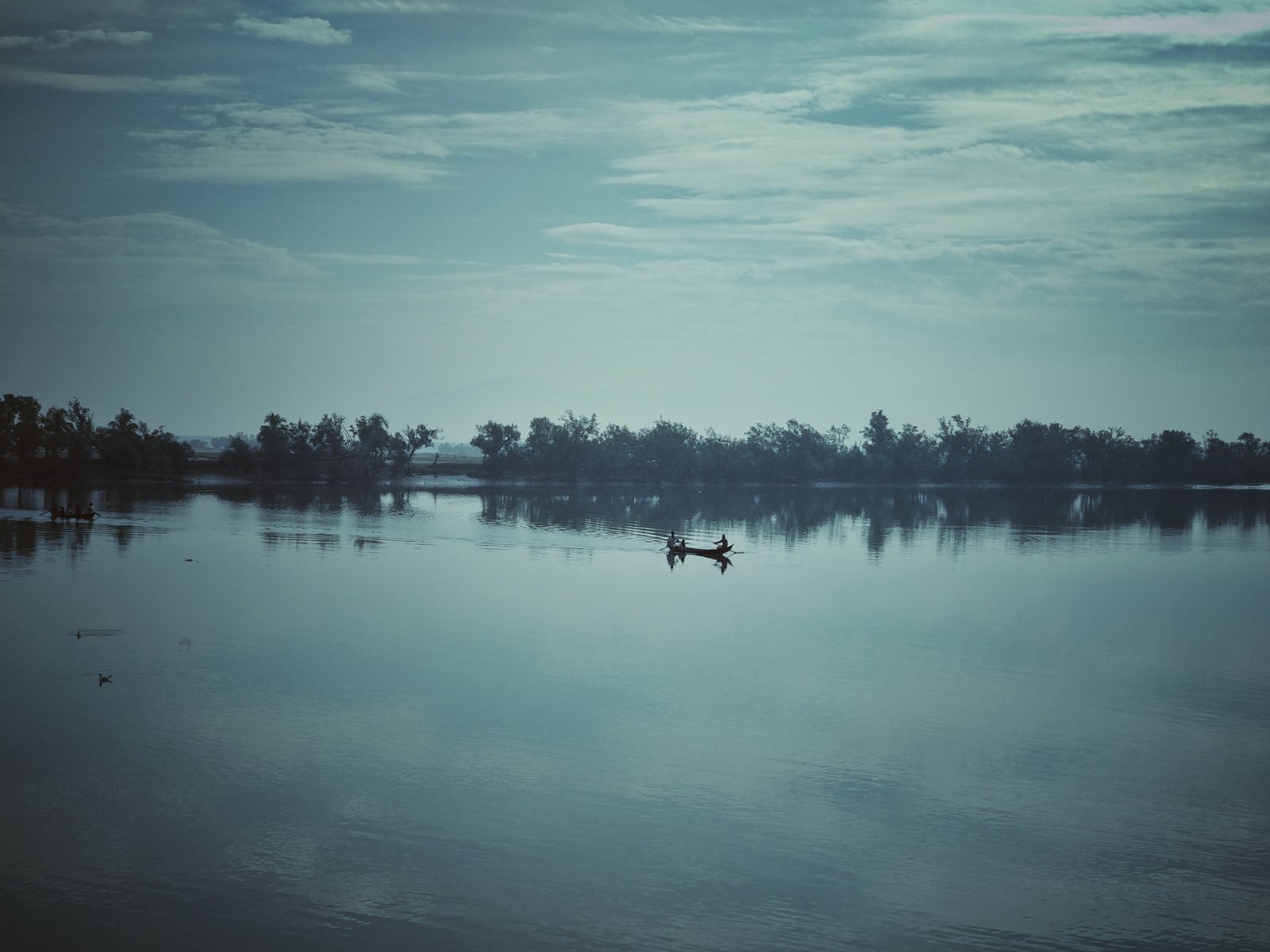
Three kinds of people meet on that water, and the interesting thing is where they touch.
At the top sit the Bangladeshi syndicates, the financiers and the godfathers who own the trawlers and pay the bribes. Even the country's own home minister has conceded that enforcement must reach the masterminds and the financiers: at a DNC event he said the government was "not limiting its action to retailers or carriers, but was also committed to bringing the masterminds, financiers and godfathers of the drug trade to justice." (The Daily Star) That is a quiet admission that the men in handcuffs are never the men who matter. A specialist at Dhaka University put it more bluntly, calling the whole failure a lack of political will, since the authorities, in his telling, already know the routes, the carriers, the dealers, and the users. (Towhidul Haque, The Daily Star)
In the middle, absorbing all the risk, are the Rohingya. The official line is cruder than the truth. A BGB sector commander has called them "the main traffickers," saying "they move very fast, which makes it difficult to catch them." (The Daily Star) The reality on the ground, set down in reporting across the camps, is a story of desperation and coercion, of people recruited because they have nothing and protected by no one, of camps turned into logistics hubs by armed groups that extort and abduct. The Rohingya are the layer of this trade that gets caught and gets killed. They are not its authors, and the lazy habit of casting them as the menace, rather than the used, is one this account refuses to indulge.
And underneath it all is the Arakan Army itself, which is no longer a band of guerrillas but a government in waiting. Its political wing, the United League of Arakan, has issued travel-ban orders and, through its Border Relations Office, temporary travel permits for cross-border movement. (The Irrawaddy; Mizzima) Traders describe double taxation, "once at the junta's gate and again at the AA's gate," paying three to five percent at each stop, often without receipts. (Mizzima) This is the institution through which a smuggled sack of fertilizer becomes a governing act.
The one place the record goes truly dark is the broker, the human hinge between a financier in Chittagong and a logistics officer in Rakhine. Names surface now and then in the partisan press, but they arrive wrapped in propaganda and cannot be stood up, so they stay out of this account. What is telling is the shape of the arrests themselves: one or two small figures for every enormous seizure, and never a chain leading upward. That is not clumsy policing. That is a network built to be cellular, engineered so that no single capture ever points to the man above. The dots are real. The lines between them were designed to be invisible.

From a sack to a salary
Here is where the whole argument lives or dies. Does a smuggled bag actually turn into governing power, into a paid soldier, a poured bunker, a fed child in a displacement camp? The evidence is circumstantial, but it converges hard.
Begin with scale. In the Teknaf region alone, seizures between 2020 and 2025 came to 35,895,217 yaba tablets and 149.9338 kilograms of crystal meth, worth approximately Tk 1,826 crore 52 lakh 55 thousand 100, across 2,755 cases with 1,975 accused. Those figures come from the BGB's Teknaf battalion commander, Lt. Col. Ashiqur Rahman. (Daily Sun) Nationally, Department of Narcotics Control data shows ATS tablet seizures of 42,977,219 in 2023, 22,857,751 in 2024, and 43,562,811 in 2025, a jump of 90.58 percent in a single year. (DNC Annual Drug Report 2025, via The Daily Star) And seizures, everyone in the trade will tell you, are only ever a sliver of the flow. Whatever is being caught, far more is getting through.
Then there is the word itself. The claim that methamphetamine has become a currency is not a writer's flourish. It is the on the record judgment of Bangladesh's own drug control chief, who said supply had surged because the Myanmar rebels were using yaba as a "narco currency." (DNC Director General Md. Hasan Maruf, The Daily Star) His own institution named the thing. The reporting around it framed the barter plainly, as a trade that sustains the rebels' civil administration in spite of the junta's economic stranglehold.
Follow the chain to its end. The evidence supports the narrower, sturdier claim about the Arakan Army's role: it facilitates, taxes, and settles in this trade, rather than cooking the drugs itself or directing every pill from the top, and it denies any role at all. The drugs go south into Bangladesh as the export. Fuel and fertilizer and cement and rice and medicine come back as the import. And the administration hands those goods out, fertilizer to farmers so that its people do not starve and turn against it, food to more than 600,000 displaced people counted by the ULA's own humanitarian and development coordination office in its 2025 report, cement to whatever is being rebuilt. (Burma News International) The proceeds sustain an army estimated at around 40,000 regular troops after its conscription drive, the largest ethnic armed force in the country. (Jamestown Foundation; Al Jazeera)
Two temptations have to be resisted right here, because this is exactly where analysis loves to overreach. The first is cement. As the rebels shifted from hit and run fighting to holding towns under air attack, it is natural to assume the smuggled cement went straight into bunkers and tunnels. Fortify Rights has documented the Arakan Army forcing ethnic minority civilians at gunpoint to build or repair fortifications, trenches and bunkers; the AA and its political wing denied the allegations. (Fortify Rights) That the forced labor is documented is a matter of record. That the specific cement in these specific seizures ended up in those specific walls is a reasonable guess, and it should be labeled a guess and nothing firmer.
The second temptation is darker. The most alarming version of this story holds that smuggled fertilizer is feeding bombs, that urea is being cooked into the explosives of a war. The chemistry is real, and reporters have established that urea is an ingredient in Myanmar's munitions. But that reporting is about the junta, resupplied by Iran's shadow tankers, and not about the rebels. Reuters documented Iranian urea, 400,000 to 600,000 tons a year moved by sanctioned tankers, being used by the junta to manufacture explosives. (Reuters) For the Arakan Army specifically, there is no primary evidence of fertilizer becoming ordnance. The far better documented use of that fertilizer is dull and human: keeping a besieged population's farms alive. When the sensational explanation and the boring one compete, and only the boring one has evidence behind it, a serious account chooses the boring one.
So is the whole rebel state balanced on this one corridor? No. The Arakan Army has other money, from border tariffs, business taxes, fisheries, timber, ransom, and a diaspora that sends what it can. (That inventory is broadly reported but not line-item verified; it is kept here as the author's summary.) Seal the corridor tomorrow and the rebels would not fall. But they would hurt, and they would hurt in the place they can least afford it, in their ability to feed and shelter the people whose loyalty is the entire foundation of the state they are trying to build. The corridor is not the whole house. It is a load-bearing wall.
Two hands, and the law that grabs at smoke
And now the contradiction that the whole story has been circling.
Bangladesh runs a hard border. It has radar, patrol boats, near daily seizures, and a recent history of lethal drug enforcement so severe that Amnesty International counted 466 suspected extrajudicial executions in a single year, 2018, killings it described as extrajudicial killings dressed up as crossfire. (Amnesty International) And yet bulk goods flow out to a foreign insurgency more or less without pause, while the state's own officials admit they know the names. Incapacity, tolerance, or complicity?
The honest answer is that all three are true, at different heights. There is genuine incapacity out on the water, because no coast guard on earth stops two dozen trawlers scattered across a dark bay on a moonless night. There is ordinary corruption down at the dealer and the local official, the two-thousand-taka bag sold out the back, the checkpoint nobody questions. And there is something colder at the level of policy, a strategic tolerance, because Dhaka is at this very moment talking to the Arakan Army, over the border, over the kidnapped fishermen, over the enormous unresolved question of whether a million Rohingya refugees can ever go home to a territory the rebels now rule. A government that needs the Arakan Army as a partner has a powerful reason not to strangle the Arakan Army's lifeline. That dissonance is not a malfunction. It is an unspoken bargain. What the evidence does not support, and what this account will not claim, is that the Bangladeshi state is complicit as a matter of deliberate policy. That would be a leap the facts cannot carry.
Into this uneasy equilibrium, on 13 July 2026, landed Dhaka's newest weapon. Parliament passed an amendment to the narcotics law that keeps the death penalty for drug trafficking carried out through cyberspace, and criminalizes the use of websites, social media, apps, and, spelled out by name, digital payments, e-wallets, virtual assets, and cryptocurrencies to move drug money. Prosecutors can now build a case on digital and financial evidence even when no drugs are ever recovered. There are to be dedicated tribunals. The home minister tabled it. It passed on a voice vote. (The Daily Star, parliament watch)
Read it against the machine this article has described, and something almost poignant emerges. The law is aimed with real precision at a surface the wholesale corridor does not touch. The engine of this trade runs offline. It runs on wooden trawlers, on mid-sea handovers in the dark, on physical barter, and on a hawala system that by its nature never goes near the digital rails the new statute polices. The law will land on the retail edge, on the street dealer taking payment through a phone app, and that edge is real. But it is the tail, not the beast. If anything, capital punishment on the digital surface will push the retail trade deeper into cash and encryption, into the same darkness the wholesale layer has always enjoyed. Pressure of this kind tends to harden a network rather than dissolve it. We have seen the rehearsal already: the executions of 2018 killed hundreds of low-level carriers, and the DNC's own seizure figures kept climbing afterward.
Whether this law becomes something more than a gesture rests on a single question that cannot yet be answered, because the ink is barely dry. Will prosecutors turn its new powers on the financiers, the men who move value without ever touching a pill, or only on the street dealers who are easy to catch and easy to hang? The first six to twelve months of cases, sorted by who actually ends up in the dock, will tell. Until then, against the corridor that matters, it is deterrence aimed at a shadow.
The larger board
Step back one more time and the frontier turns out to sit under the gaze of great powers who each have a stake in looking away.
China manages the Arakan Army from the north, brokering ceasefires in Kunming, controlling the border gates, and guarding its deep sea port at Kyaukphyu, its twin oil and gas pipelines running up into Yunnan, and the investments it has sunk into Rakhine. (Al Jazeera) Because Beijing controls the northern taps and prizes the stability of its own corridor above all, the rebels cannot freely buy bulk civilian goods across the Chinese line for their western heartland. And so the pressure pushes west, toward the Bangladeshi sea, the path of least resistance for fuel and fertilizer and cement. Beijing ends up with influence over both sides of the war and a shield around its port, and pays nothing for the rebels' governance. Whether it funds the Arakan Army directly is unproven.
India has made a different bet, a transit project meant to link Kolkata by sea to Sittwe, then up the river to Paletwa and over a road into India's landlocked northeast. That corridor now runs straight through rebel-held ground, which nudges New Delhi toward the same quiet accommodation with the Arakan Army that Dhaka has already begun. The route, Kolkata to Sittwe by sea, Sittwe to Paletwa by river, Paletwa to Zorinpui in Mizoram by road, was projected by India's shipping minister to be fully operational by 2027. (The Daily Star) Should that project ever come fully alive, it might, over years, give the rebels a legal western artery and loosen their dependence on the trade in pills. Might. That is a long horizon and a thin thread.
And binding it all together is the cruelest knot of all, the Rohingya. Repatriation politics tie Dhaka to the Arakan Army, because the rebels are now the authority in the very homeland the refugees fled. Yet in the same season, the AA stands accused of atrocities against Rohingya in the villages it captured: local accounts cited in the press put one village death toll at 150, a figure I have not been able to independently confirm, alongside the forced labor documented by Fortify Rights. (Fortify Rights) So the rebels are at once Dhaka's necessary interlocutor and a documented abuser of the exact people Dhaka is trying to send home. There is no clean position to hold in that sentence, which is precisely why it is the truest one in this story.
What we know, and what we do not
I have spent enough years around frontier stories to be wary of the ones that resolve too neatly, so let me end where an honest account should, with the seams showing.
The strong version of this story does survive scrutiny, but only after two corrections that matter. The first is a verb. The Arakan Army facilitates, taxes, and settles in this trade. It has not been shown to manufacture the drugs or to direct every pill from the top, and it denies any role at all. The evidence supports the narrower, sturdier claim, and the narrower claim is damning enough. The second correction is about time. This is not a currency conjured out of nothing. It is a profit trade, old as the coastline, that acquired a monetary function under the pressure of a siege. The mutation is real. The invention is not.
With those corrections made, the load-bearing facts hold. The blockade is real and documented by the UN. The famine is real. The rebels' near-total control is real. The shift to the sea, the official use of the word currency, the new law, all real. The rest is careful inference resting on evidence that points the same way.
What remains genuinely unknown is a matter of magnitude and of names. No auditable ledger exists to tell us what share of the rebel state's finances actually flows through this corridor. The broker who connects the money to the movement remains, by deliberate design, a ghost. Those are gaps in the accounting and in the roster, not in the mechanism. The machine itself is not in doubt.
So here is where it leaves us. On a river between a country and a rebel state, fertilizer meant to feed a nation's farmers crosses the water, and methamphetamine that will hollow out that same nation's children crosses back. A siege meant to starve an army into surrender taught it instead to eat. And the newest law the region has raised against all of this was built, with real care and real conviction, to police the one surface the machine has never once run on. The seizure record through the summer of 2026 shows the corridor still moving after the vote. Somewhere on the dark water between the two shores, a sack of nitrogen is changing hands for a box of pills, and both sides believe they are getting the better end of the deal. The terrible arithmetic of the corridor is that, for now, they both are.
Dated 21 September 2026
Dated 2026-09-21. Prepared during a forensic re-verification of the original 2026-07-15 Substack post for newsroom import.
- The original stated that seizures in the Teknaf region between 2020 and 2025 totaled "nearly three hundred and fifty-nine million yaba tablets." The cited source, a Daily Sun interview with BGB Teknaf Battalion Commander Lt. Col. Ashiqur Rahman, reports 3,58,95,217 tablets, which is about 35.9 million, not 359 million. The draft uses 35,895,217.
- The original stated that the price of rice in Maungdaw had climbed "by more than nine hundred percent." The UNDP figure it rested on is a 944 percent increase. The draft uses 944 percent. (UNDP, "Rakhine: A Famine in the Making," November 2024)
- The original stated that Paletwa fell in February 2024. AP and Al Jazeera reporting put the Arakan Army's capture of Paletwa at mid-January 2024. The draft uses January 2024.
- The original stated that "four thousand acres of forest" were cleared for the refugee camps. A UNDP and UN Women environmental-impact survey found 4,300 acres of hills and forests cut for shelters, facilities and firewood in Ukhiya and Teknaf. The draft uses 4,300 acres.
In addition, several claims from the original that could not be verified were removed or labeled: the composite joint-operation seizure figures, three specific pill-seizure incidents, the counterfeit-sack detail, the 80 percent maritime share and daily trawler counts, the Dhaka user-population estimates, and the founding year of the ULA's humanitarian office. The full verdict list is in factcheck.md.