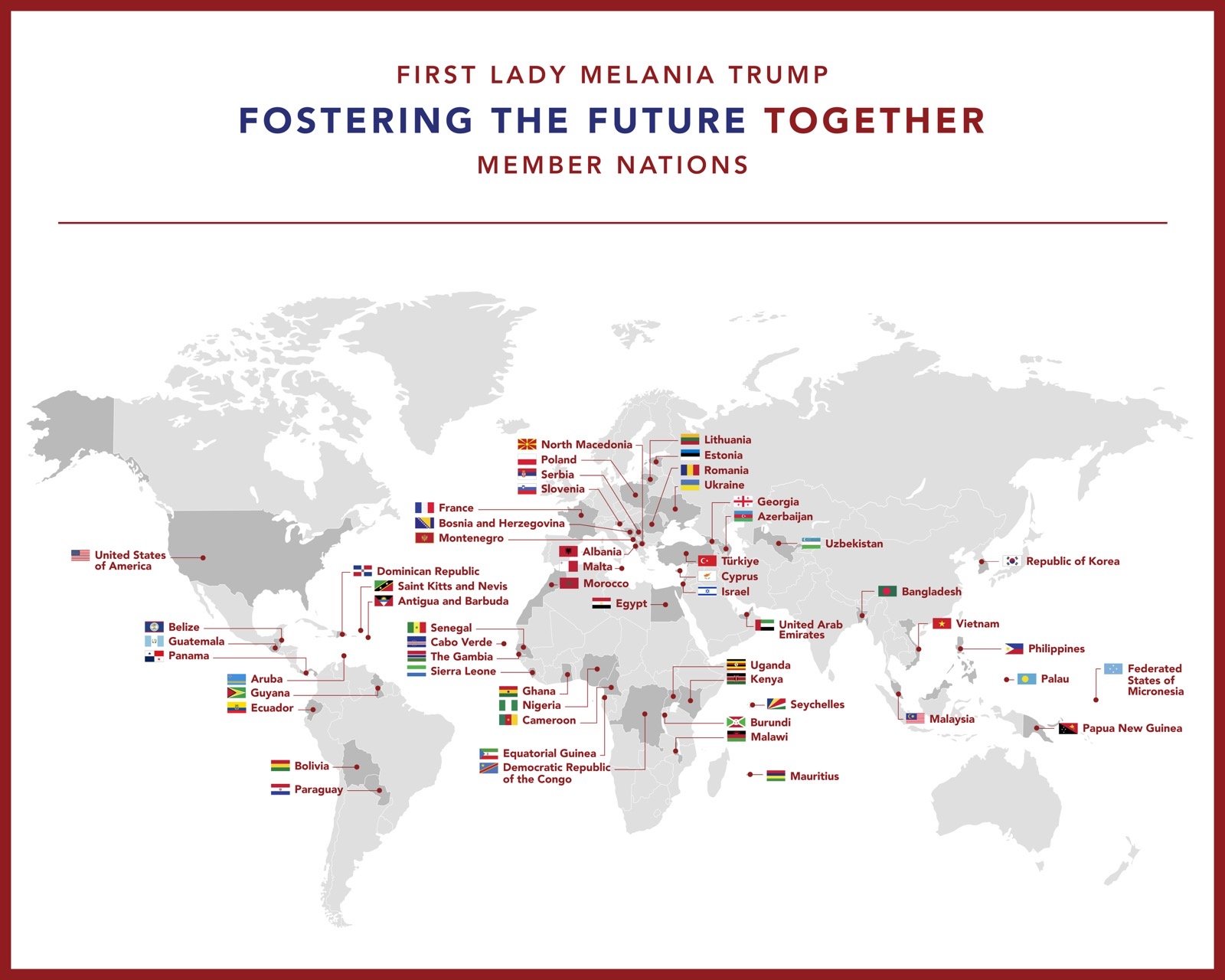
Fifty-seven flags on a map is a diplomatic fact. What the map does not show is the price of admission. Bangladesh's flag sits among the original 45, placed there in March by a four-person delegation led by the prime minister's wife. Six months later, Dhaka signed for eleven more Boeing aircraft in New York. Read the two events together and a pattern emerges: a small state buying proximity on every counter Washington opens. Facts first, inference labeled.
What the coalition is
"Fostering the Future Together" is Melania Trump's global coalition, launched on September 23, 2025, on the margins of the 80th UN General Assembly. The stated mission is children's well-being through education, innovation, and technology, so that "every child can flourish in the digital era." Membership runs spouse-to-spouse: first spouses, or their equivalents, with each country implementing locally.
The inaugural summit ran March 24 and 25, 2026: day one at the State Department, with a working session and a Technology Expo, and day two at the White House. The White House billed it as the first time a First Lady hosted representatives of 45 nations in a single day. The official count was 45 nations and 28 "technology entities," the office's own phrase.
By September 2026 the roster had grown to 57, per a State Department media note dated September 21. At a September 22 event on the UNGA margins, seven new technology partnerships were announced: Adobe, Amazon, Google, Intel, N50, Starlink, and Zoom, extending educational and technological access to more than 15 nations. The coalition's four stated pillars are AI in Education, EdTech Tools, Online Protection, and Digital Skills. The Republic of Korea had joined in October 2025 through a "Technology Prosperity Deal" built with the White House science office. Regional meetings are now scheduled on four fronts: the Philippines hosts an ASEAN event, Poland a European one, St. Kitts and Nevis a Caribbean one, and a G20 event lands in Miami in December.
One disclosure is missing from every release: money. No funding figures, pledges, or budgets for the coalition itself have been announced anywhere I could find. The companies, the White House said in October 2025, "agree to make these advancements available to participating countries, either at no cost or very low cost." What that costs, who covers the gap, and who audits delivery is unpublished.
The tech roster
Eight of the 28 entities are named: OpenAI, Microsoft, xAI, Meta, Palantir, Adobe, Google, and Zoom. The other twenty have never been publicly listed. Melania Trump's own summit remarks grouped them as "AI pioneers like OpenAI, Palantir, and xAI," "tech platforms like Google and Meta," "creative engines like Adobe and Microsoft," and "human connectivity through Zoom Communications."
Inference, labeled: a children's education banner stretched over 28 American technology firms and 57 member states is also a distribution channel. It is a US ed-tech and AI market being assembled diplomatically, with first spouses as the procurement officers. The name on the list that does the most work is Palantir, a data-analytics firm built on defense and intelligence contracts, seated at a children's coalition table. Nobody has explained what a child in Malawi gets from that seat, or what Palantir gets from 57 governments' education systems. Both questions are open.
Inference, labeled: read the member map as a diplomatic sign-up sheet, not a needs assessment. The Eastern European cluster, Poland, Lithuania, Estonia, Romania, Ukraine, Serbia, plus the Balkan states, reads as countries that want proximity to the American security umbrella. The Pacific microstates, Palau, Micronesia, Papua New Guinea, the Philippines, are the standard US-aligned island roster. One caution on absences: the UK and Canada attended the September 2026 event but do not appear on the 57-flag map, so attendance and membership are not the same thing, and any reading of who is missing should carry that caveat.
Bangladesh's seat
Bangladesh was among the original 45. The delegation that carried the flag was led by Dr. Zubaida Rahman, wife of Prime Minister Tarique Rahman: four people, departed Dhaka on March 22, spoke at the opening session about the family card and farmers' card programs, held a courtesy meeting with Melania Trump, and attended the White House closing session on March 25. No separate join date was ever announced; the summit itself is the first documented participation.
That detail is worth pausing on. The delegation was not led by a minister or an ambassador. It was led by the prime minister's spouse, because the coalition is built spouse-to-spouse. For a government elected only weeks earlier, it was a direct line to the White House that bypassed every ministry.
The other ledger
Six weeks before that summit, on February 9, 2026, the interim government signed a Reciprocal Trade Agreement with the United States, three days before the national elections, negotiated under a non-disclosure arrangement. The crisis it answered began with Executive Order 14257 in April 2025, which put a 37 percent retaliatory surcharge on Bangladeshi goods. The agreement cut the reciprocal rate to 19 percent. Against the underlying most-favored-nation tariff of about 15 percent, total duties still run near 34 percent.
The price of that cut is written into Annex III, Section 6: roughly $21.5 billion in mandatory purchases of American goods, with Boeing aircraft, LNG, wheat, soybeans, and defense equipment on the list. Miss the purchase benchmarks and the tariffs snap back.
The line items, as reported: 14 Boeing aircraft in the agreement's aviation clause, and Biman signed 11 more in New York in September 2026, taking planned Boeing orders to 25. The full aviation ledger is in Ledger in the Sky. About $15 billion of American LNG over 15 years. At least $3.5 billion of wheat and soybeans. A defense clause committing Bangladesh to buy more American military equipment while limiting purchases from "certain countries"; a leaked draft named China. Article 4.3 lets Washington terminate the entire agreement if Dhaka signs a trade deal with a "non-market country," the US regulatory term for China and Russia, and obliges Dhaka to adopt "complementary restrictive measures" alongside American sanctions.
The headline concession, a zero-tariff lane for garments made with American cotton or man-made fiber, is narrower than Dhaka's first press releases suggested: it waives only the reciprocal component, not the underlying MFN tariff, and only up to a fixed volume. Two Bangladeshi outlets allege the wheat is priced at one and a half times the market and the LNG above market. Those are single-source allegations, not established facts, and I am marking them as such.
Two ledgers, one strategy
Inference, labeled: the coalition seat and the trade agreement are the same transaction in two currencies. One buys goodwill at the White House through the First Lady's office; the other buys tariff relief through the trade representative's. Both convert Bangladeshi procurement, jets, gas, wheat, weapons, into American proximity.
This is not mysterious, and it is not uniquely Bangladeshi. A small state facing a tariff-wielding superpower does not get to choose which ledger it is written into. It gets to choose whether it is in the book at all. Dhaka chose to be in it three times over: a shopping list in February, a spouse's handshake in March, and eleven aircraft in September.
The question worth keeping is not whether the strategy works this year. It is what happens to the 57-flag map, and to the $21.5 billion in purchase orders, when the administration that drew them leaves office. Coalitions built spouse-to-spouse and deals built tariff-to-tariff share the same expiry risk: they are personal, not institutional. Dhaka has now tied its aviation fleet, its gas supply, its wheat imports, and its defense procurement to a single bilateral relationship, under termination clauses the other side wrote. That is the actual shopping list. The map is just the receipt.
A note on method, for anyone who wants to check my work
Coalition figures come from White House and State Department releases dated September 2025, October 2025, March 2026, and September 2026; summit attendance from the First Lady's published remarks; the Bangladesh delegation's details from The Daily Star and the Dhaka Tribune; trade agreement terms from the USTR-published text as reported by TBS News and The Daily Star; Boeing figures from Reuters via this newsroom's own Ledger in the Sky. Allegations of above-market wheat and LNG pricing are single-sourced and labeled as allegations throughout. No funding or budget figures for the coalition have been disclosed in any source found. The member map graphic was supplied by the author and is believed to be an Office of the First Lady roster graphic; its original posting could not be verified.
Sources
- White House, Office of the First Lady, "First Lady Melania Trump Launches a Global Coalition for Children: Fostering the Future Together," 23 Sep 2025.
- White House, "First Lady Melania Trump Launches Fostering the Future Together: 45 Member Nations Attend the Inaugural Coalition Summit," Mar 2026.
- White House, "First Lady Melania Trump's Fostering the Future Together Assembles Leaders from 45 Nations and 28 Tech Entities," Mar 2026.
- US State Department, "First Lady Melania Trump's Fostering the Future Together Secures New Tech Private-Sector Partnerships to Benefit Children," 21 Sep 2026.
- White House, "First Lady Melania Trump Unveils New Fostering the Future Together Technology Alliances, International Events, and Membership Expansion," Sep 2026.
- White House, "The Republic of Korea Joins First Lady Melania Trump's Fostering the Future Together," Oct 2025.
- The Daily Star, "Zubaida leaves for US to join Fostering the Future Together global coalition," Mar 2026.
- Dhaka Tribune, "Dr Zubaida Rahman attends closing session of Fostering the Future Together summit," Mar 2026.
- TBS News, "The price of tariff relief: Why Bangladesh's trade deal with Washington demands scrutiny," Feb 2026.
- TBS News, "Bangladesh has to raise US defence imports under trade deal," 11 Feb 2026.
- The Daily Star, "US tariff cut comes at a steep cost," 2026.
- The Daily Star, "How Asia negotiated with Washington while Bangladesh lost out," 2026.
- BDDiGEST, "Despite Billions in Purchases from the U.S., Yunus Administration Receives Only 1% Tariff Exemption," 9 Feb 2026 (above-market pricing allegations).