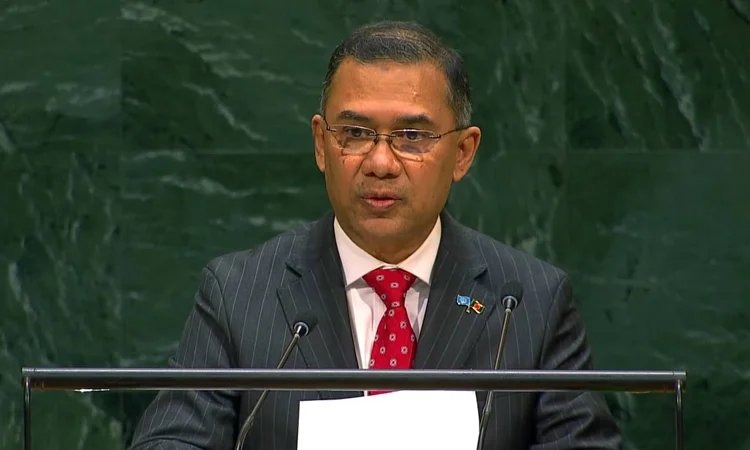
Tarique Rahman spent the hours before the most-watched speech of his premiership demanding climate money. At the Trusteeship Council Chamber on the morning of 24 September, in a session convened by António Guterres, Bangladesh's prime minister laid five demands on the international community and priced the country's vulnerability: under 0.5 percent of global emissions, one percent of GDP already lost, $3.19 billion allocated from a budget that cannot stretch. The maiden address to the General Assembly came at 6:18pm New York time, 4:18am Friday in Dhaka, in Bangla, and ran twenty-one minutes, six past the fifteen on the clock.
Climate ledger
The morning session was "Climate Action and the Just Transition," a high-level meeting held at the UN Headquarters as part of the 81st session's high-level week, with heads of state, international organisations, multilateral development banks, businesses, and civil society in the room. Rahman's five urgent measures: hold the 1.5°C Paris Agreement limit; make adaptation finance predictable and accessible for climate-vulnerable countries; widen access to climate-smart technologies; scale up renewables through finance and technology transfer; and fully implement and regularly replenish the Loss and Damage Fund.
"Let us act together to build a safer and more sustainable future for generations to come."
The figures he attached to the ask: Bangladesh accounts for less than 0.5 percent of global greenhouse gas emissions yet ranks among the most climate-vulnerable nations. "By the end of this century, 12 to 18 percent of our coastal areas could be submerged by sea-level rise, affecting the livelihoods of tens of millions." Climate change has already inflicted loss and damage worth one percent of Bangladesh's GDP, with food security under serious risk. "Yet, without international support, we risk severe damage."
On the domestic side of the ledger: nearly $3.19 billion allocated in the current budget for climate adaptation; 250 million trees to be planted over five years; roughly 20,000 kilometres of rivers and canals to be excavated alongside the Padma Barrage and Teesta Barrage Master Plan, aimed at retaining water, cutting flood risks, reviving wetlands, and recharging groundwater. On clean energy: 20 percent of electricity from renewables by 2030, green industries spanning jute products, eco-friendly transport, waste-to-energy, and the circular economy, plus a national carbon market.
"Collective action based on 'Common but Differentiated Responsibilities and Respective Capabilities' is imperative. Bangladesh seeks partnerships that help us implement our plans."
Read the quotes straight: this is a government pricing its exposure before asking others to pay. The CBDR line is the standard developing-country shield; the $3.19 billion and the tree and river numbers are the receipt meant to show Dhaka is spending first. Whether the five demands survive into tonight's speech verbatim will show how much of the day was posture and how much is policy.
Day's diary
The schedule between the climate meeting and the evening address is a full bilateral diary. Rahman attends a high-level meeting on the threats of rising sea levels and gives the opening remarks, then opens a high-level event on integrating midwifery into primary healthcare to prevent maternal and newborn deaths. On the bilateral track: a meeting with Pakistani Prime Minister Muhammad Shehbaz Sharif, then sessions with UN Secretary-General António Guterres and Thai Prime Minister Anutin Charnvirakul, before joining the general debate.
Tomorrow's diary is economic. A breakfast with Wall Street representatives hosted by JPMorgan at its Manhattan headquarters, a meeting with Kuwait's Crown Prince Sheikh Sabah Khaled Al-Hamad Al-Sabah, lunch with Prince Zeid Ra'ad Al Hussein, president of the International Peace Institute, and a session with BNP leaders based in the United States. He departs New York at 11:00pm on Emirates flight EK202 via Dubai and is scheduled to reach Dhaka on 27 September.
Speech at dusk
The address is delivered, and the transcript is on the record in the BSS-carried full text. Bangla, twenty-one minutes, beginning 6:18pm New York time after the schedule slipped, as schedules do. The spine is the one the pre-brief promised, with one addition that now has a name. "After ending more than a decade and a half of fascist rule and exploitation, Bangladesh became free from fascism in 2024," Rahman said, and the governing doctrine for repairing a country "battered by fascist rule and exploitation" is the 3-R strategy: Recovery, Restoration and Reconstruction. The February 12 election, "free, fair and impartial," gave the BNP its mandate; "the people are the source of all our political power." He opened with tribute to the 1971 martyrs, to those killed in the democracy struggles since independence, and to the martyred and injured of the July-August 2024 uprising.
The family arithmetic closed as written. "Standing before the United Nations General Assembly, I feel somewhat nostalgic," he said: his father Ziaur Rahman on that platform in 1980, his mother Khaleda Zia in 1993, and now the third of the family across forty-six years, in the Bangla tradition running back to Sheikh Mujibur Rahman's 1974 address. He closed the way it opened, with the banner "Bangladesh First: Bangladesh for All" and "Bangladesh Zindabad."
On peace, the doctrine is dialogue: "any conflict should be resolved through dialogue, diplomatic processes and mutual cooperation," with complete disarmament, nuclear non-proliferation and arms control reaffirmed, and the diversion of development budgets to military spending named as an obstacle to world peace. Palestine got its own line: "unwavering support" for self-determination and an independent State of Palestine. Multilateralism got the institutional version: Vice-Chair of the Peacebuilding Commission, Bangladeshi peacekeepers "serving humanity" abroad, women in peacekeeping missions as the Women, Peace and Security credential, and a migration plank calling for regular, safe and orderly migration with rights, dignity and welfare for migrants.
On the Rohingya, the line held and hardened. More than 1.2 million forcibly displaced, sheltered for more than nine years, "immense pressure" on resources, environment, security and local communities. The source and origin of the crisis lie in Myanmar, so the solution lies there; "the only solution to this problem is the safe return of the displaced Rohingya population to their homeland." He asked the UN to keep life-saving assistance flowing until repatriation, and added the warning that goes past the standard formula: "If the international community fails to ensure justice for the displaced Rohingya population, this may turn into a humanitarian crisis in the near future." The five concrete measures stayed where they were tabled, at the 23 September side event; the podium added urgency language, not a funding mechanism.
The climate section did not repeat the morning's five demands verbatim; it went further on domestic targets. Bangladesh expects "stronger global action at COP31 on climate justice, climate finance and adaptation support," then put its own numbers on the table: 250 million trees over five years, 20,000 kilometres of canals excavated against floods and droughts, the Teesta Master Plan and the Padma Barrage moving to push freshwater into the Sundarbans, and the 1992 Water Convention signed for trans-boundary cooperation. The morning priced the exposure; the evening priced the response.
Women got the longest domestic passage: more than half the population, "at the forefront of all government plans," with priority for women's education, employment and entrepreneurs, expanded cash financing for women-led small and medium industries, free education for women up to the undergraduate level, and the Family Card, issued in the female head's name, held up as "a symbol of women's economic empowerment." The economy got the manufacturing-hub pitch with US$50 million for youth startups, the 31-point programme mapped at 73 percent direct and 27 percent indirect alignment with the SDGs' "Leave No One Behind," the highest-ever education budget allocation with a 5-percent-of-GDP target inside five years, and a technology passage warning that the digital divide must not become "tomorrow's artificial intelligence divide," with a call for a UN policy framework on AI. On LDC graduation, the ask was continued support — assured financing, greater market access, technology transfer, capacity building — while the deferral decision itself stayed off the week's agenda. The closing line: "A state can never become strong by keeping its citizens powerless."
The five observables, resolved
First, the transcript against the pre-brief. It matches the spine Siam laid out, in roughly the order briefed, with the 3-R doctrine as the notable addition. One soft spot: multilateral reform never became a reform pitch, only a call for a UN policy framework on AI and social media. Omissions, as promised, are data.
Second, the climate section. It did not repeat the morning's five demands verbatim. It went further with domestic targets and timelines — the trees, the canals, the barrages — while the international ask narrowed to COP31 on justice, finance and adaptation.
Third, the bilateral readouts. All three happened: Sharif, Guterres and Anutin Charnvirakul sit on the Dhaka Tribune's confirmed meeting list. No detailed readouts with deliverables have surfaced; the PMO's line is agenda talk — trade, investment, manpower, energy. Handshakes, then.
Fourth, the Rohingya thread. The side event's five points stayed at the side event. The speech held the repatriation line and hardened it with the justice-warning. Movement, but in tone rather than mechanism.
Fifth, the LDC deferral. The premise was wrong, and the correction is dated: no decision came in this session. The Financial Express reports ECOSOC will not place the proposal this time, with the decision expected in October or early November; the CDP has already backed extending the preparatory period to November 2029. The most important economic item of the week is still waiting on a room in New York.
Sources
- TBS News, "PM seeks collective actions to build sustainable future for next generations," 24 Sep 2026.
- Voice7 News, "Tarique Rahman Arrives in New York for 81st UN General Assembly," Sep 2026.
- Bay of Bengal Post, "Bangladesh PM Tarique Rahman set to become third family member to address UN General Assembly," 20 Sep 2026.
- TBS News, "Tarique Rahman set to address UNGA as third member of family," Sep 2026.
- viewsbangladesh.com, "PM Tarique Rahman to deliver UNGA speech in Bangla," 20 Sep 2026.
- fact.net.in, "Tarique Rahman to make UNGA debut on Sept 24, Rohingya crisis and climate change in focus," Sep 2026.
- Bay of Bengal Post, "PM Tarique Rahman to Put Rohingya Crisis at Centre of Bangladesh's UNGA Agenda," 21 Sep 2026.
- BSS, "Full text of Prime Minister's speech at UNGA | 81st session of the UN General Assembly," bssnews.net, 24 Sep 2026.
- Dhaka Tribune, "PM Tarique heads home after five-day UNGA visit," 26 Sep 2026.
- The Financial Express, "LDC graduation deferment confirmation unlikely during this UNGA session," 26 Sep 2026.
- Daily Sun, "PM Tarique Rahman addresses UNGA for first time," 25 Sep 2026.